Local SEO for Jewelry Stores: Complete 2026 Strategy Guide to Dominate Local Search
by Eric Barker · November 8, 2025
Smart, fast, and measurable. Here's how local seo helps Jewelry Stores win.
When someone searches for "engagement rings near me" or "jewelry repair downtown," your store needs to appear in those critical first three local pack results. Local SEO for jewelry stores isn't optional anymore—it's the difference between a thriving showroom and an empty one. With 97% of consumers searching online for local businesses and 76% of people who search for something nearby visiting a business within 24 hours, your local search visibility directly impacts foot traffic and revenue.
Unlike traditional SEO that competes nationally, local SEO targets customers in your immediate area who are ready to buy. For jewelry stores, where trust, proximity, and in-person consultations matter immensely, dominating local search results means capturing high-intent shoppers at the exact moment they're looking for your services. This guide delivers a comprehensive, actionable framework to build your jewelry store's local SEO presence from the ground up—covering Google Business Profile optimization, citation management, location page strategies, and review generation tactics that convert searchers into customers.
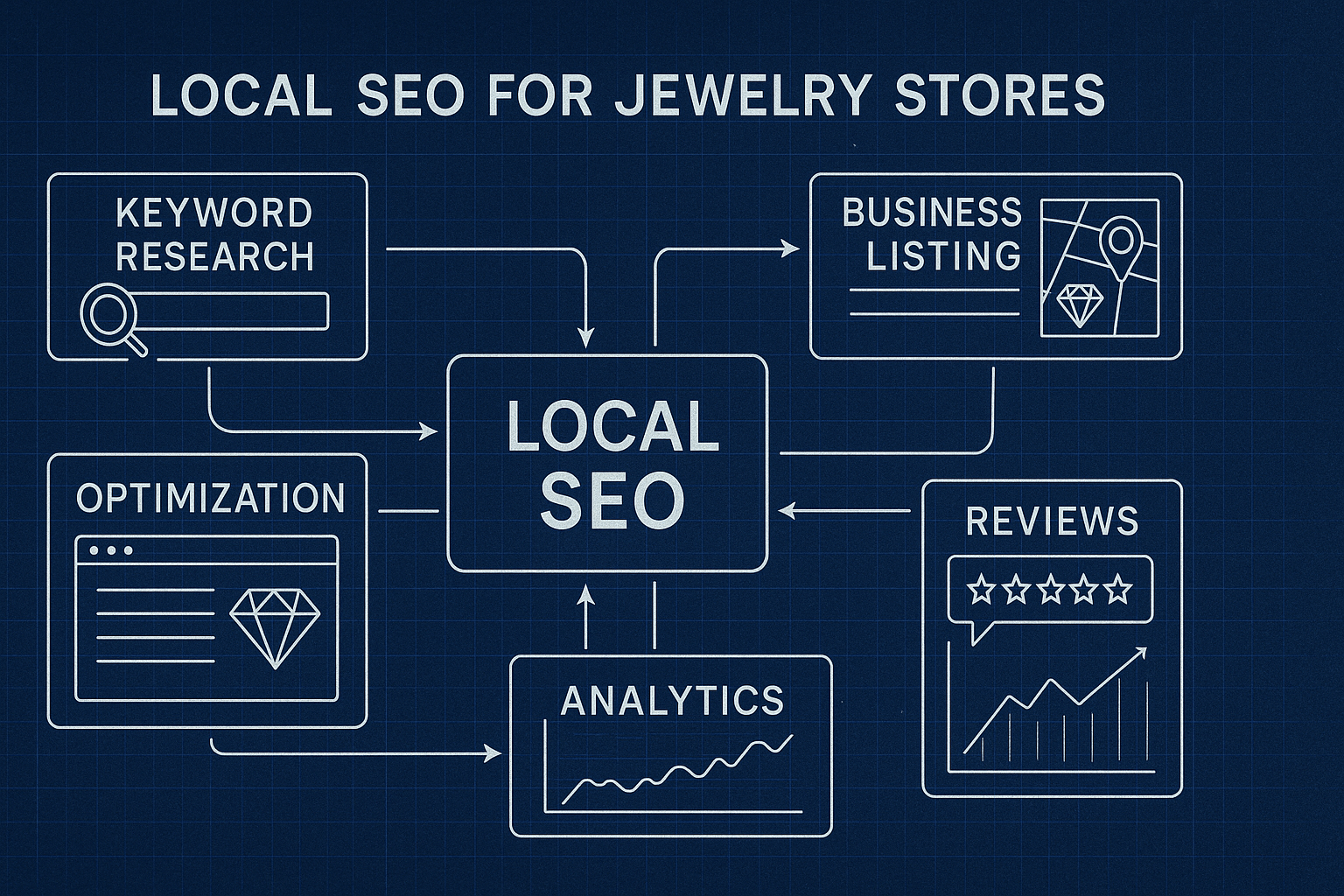
Why Local SEO Is Critical for Jewelry Stores in 2026
The jewelry industry faces unique competitive dynamics in local search. High-value transactions, emotional purchases, and the need for trust create a perfect storm where local visibility becomes your most valuable marketing asset. Customers aren't buying jewelry sight-unseen from across the country—they're walking into stores within 10 miles of their home or workplace.
Consider the customer journey: Someone gets engaged and immediately searches "engagement ring jewelers near me" on their phone. Google displays the local 3-pack—those three businesses with maps, ratings, and quick information. If you're not there, you're invisible to a customer ready to spend thousands of dollars. Local SEO puts you in that 3-pack consistently.
The financial impact is measurable. Jewelry stores that invest in local SEO see 3-5x more qualified foot traffic, higher average transaction values from local customers, and dramatically lower customer acquisition costs compared to paid advertising. You're not competing with every jeweler globally—you're winning against the 15-20 stores in your metropolitan area. That's a winnable game with the right strategy.
Key factors driving local SEO importance for jewelry stores:
- Purchase intent: Local jewelry searches have 89% higher purchase intent than general searches
- Mobile dominance: 68% of jewelry-related local searches happen on mobile devices
- Review influence: 91% of jewelry buyers read reviews before visiting a store
- Competition gaps: Most independent jewelers still haven't optimized their local presence
- Trust signals: Local pack placement creates immediate credibility and authority
Google Business Profile Optimization: Your Foundation
Your Google Business Profile (GBP) is the single most important local SEO asset you control. It determines whether you appear in the local 3-pack, how you display in Google Maps, and what information customers see before they ever visit your website. A fully optimized GBP can increase visibility by 300% and drive 2-3x more calls and direction requests.
Essential GBP Elements for Jewelry Stores
Business information accuracy: Start with the fundamentals. Your business name, address, and phone number (NAP) must be identical across your GBP, website, and every citation. Use your legal business name exactly as registered—no keyword stuffing like "Best Engagement Rings NYC Jeweler." Include your primary phone number that customers actually reach you at, and ensure your address matches your physical location exactly, including suite numbers.
Category selection strategy: Choose "Jewelry Store" as your primary category, then add secondary categories that reflect your actual services: "Jewelry Appraiser," "Jewelry Repair Service," "Jewelry Buyer," "Watch Repair Service," or "Diamond Dealer." Categories directly influence which searches you appear for, so select strategically based on your revenue-generating services.
Business description optimization: Write a compelling 750-character description that includes your target keywords naturally while focusing on what makes you unique. Mention specific services (custom design, appraisals, repairs), your area of expertise (estate jewelry, bridal sets), and trust factors (family-owned, decades in business, certified gemologists). This description appears in search results and influences both rankings and click-through rates.
Attributes and features: Enable every relevant attribute Google offers: "Wheelchair accessible entrance," "LGBTQ+ friendly," "Appointment required," "Onsite services," "Wi-Fi available." These appear as quick filters in search results and can be deciding factors for customers choosing between stores.
Hours, Services, and Products Sections
Set regular hours accurately and keep them updated during holidays. Add special hours for events or seasonal changes immediately. Use the Services section to list individual offerings with descriptions and pricing ranges—"Engagement Ring Design: Custom-designed rings starting at $2,500" or "Jewelry Repair: Ring sizing, prong repair, chain soldering from $45." This adds keyword-rich content directly to your profile.
Populate the Products section with your bestsellers or signature pieces, including high-quality images, descriptions, and price ranges. Each product entry is indexed by Google and creates additional search visibility opportunities.
Photo and Video Strategy
Businesses with photos receive 42% more direction requests and 35% more clicks to their website. Upload fresh photos weekly, including:
- Exterior shots: Clear storefront images that help customers identify your location
- Interior ambiance: Showcase your showroom's atmosphere and layout
- Product photography: High-resolution images of jewelry pieces, organized by category
- Team photos: Put faces to names; humanize your business
- Before/after repair work: Demonstrate craftsmanship and capability
- Custom design process: Document creation stages for custom pieces
- Video tours: 30-60 second walkthroughs of your store and services
Name your photo files descriptively before uploading: "custom-engagement-ring-chicago-jeweler.jpg" rather than "IMG_4387.jpg." Google indexes image metadata.
GBP Posts for Ongoing Engagement
Publish GBP posts weekly to maintain activity signals and provide fresh content. Effective post types for jewelry stores include:
- What's New posts: Announce new collections, designers, or inventory arrivals
- Event posts: Promote trunk shows, special sales, or educational workshops
- Offer posts: Share promotions with clear call-to-action buttons
- Product posts: Highlight featured pieces with pricing and availability
Each post should include a high-quality image, 150-300 words of engaging copy, relevant keywords, and a call-to-action button. Posts remain visible for seven days, so consistent publishing maintains profile freshness.
NAP Consistency and Citation Management at Scale
Citations are online mentions of your business name, address, and phone number on directories, review sites, social platforms, and local websites. NAP consistency across the web is a critical local SEO ranking factor—inconsistent information confuses Google and dilutes your ranking power.
The Citation Audit Process
Begin with a comprehensive audit of existing citations. Search for your business name, phone number, and address variations across major platforms. Document every instance where your NAP appears, noting any inconsistencies in formatting, outdated information, or duplicate listings. Common citation sources for jewelry stores include:
- Major directories: Yelp, Yellow Pages, Bing Places, Apple Maps, MapQuest
- Industry-specific sites: The Knot, WeddingWire, Jewelers of America directory
- Local directories: Chamber of Commerce, Better Business Bureau, local city guides
- Social platforms: Facebook, Instagram, LinkedIn, Pinterest
- Review sites: Trustpilot, Google Reviews, industry review platforms
Citation Cleanup and Correction
Address inconsistencies systematically. If you've moved locations, changed phone numbers, or rebranded, update every citation to match your current information. Suppress duplicate listings by claiming and closing them or requesting removal. Standardize your NAP format everywhere: If you write "Street" in your GBP, use "Street" not "St." across all citations. If you include a suite number, include it everywhere consistently.
Building New Citations Strategically
After cleanup, expand your citation portfolio to authoritative, relevant directories. Prioritize quality over quantity—50 citations on high-authority sites outperform 200 on low-quality spam directories. Focus on:
- High domain authority directories: Sites with strong SEO profiles pass more value
- Industry-relevant platforms: Jewelry-specific directories carry more contextual weight
- Locally-relevant sites: City guides, neighborhood directories, local news sites
- Niche wedding/engagement sites: Where your target customers are researching
When building citations, include as much information as possible: full business description, website URL, email, social media profiles, business hours, payment methods accepted, and services offered. Richer citations provide more ranking signals and conversion opportunities.
Ongoing Citation Monitoring
Citations aren't set-and-forget. Use tools like Moz Local, BrightLocal, or Whitespark to monitor your citation health quarterly. Set up Google Alerts for your business name to catch new mentions. When you make business changes—new hours, additional services, rebranding—update all citations within 48 hours to maintain consistency.
Location Pages That Convert Local Traffic
If you serve multiple cities or neighborhoods, dedicated location pages are essential for ranking in each area. A well-structured location page targets local search terms while providing genuine value to visitors from that specific area. These pages should be substantive, unique, and conversion-focused—not thin, templated doorway pages that Google penalizes.
Location Page Architecture
Create a scalable URL structure: yourjewelrystore.com/locations/city-name/ or yourjewelrystore.com/city-state/. Include geographic modifiers in your H1 tag: "Fine Jewelry Store in [City Name]" or "[City]'s Premier Custom Jeweler." Your title tag should include the city, primary service, and brand: "Custom Engagement Rings [City] | [Your Store Name]."
Essential Location Page Elements
Unique, substantial content: Write 800-1,200 words of genuinely useful content for each location. Discuss your connection to that community, specific landmarks near your store, local events you participate in, neighborhoods you serve, and why local customers choose you. Avoid templated content with just the city name swapped—Google penalizes this aggressively.
Embedded Google Map: Include an interactive map showing your exact location with clear directions. This helps users and provides geographic context to search engines.
Local business schema: Implement LocalBusiness schema markup with complete NAP information, hours, geographic coordinates, accepted payment methods, and price range. This structured data helps Google understand and display your location information in rich results.
Customer testimonials by location: Feature reviews from customers in that specific area. "Sarah from [Neighborhood] says: 'I found the perfect anniversary band here...'" This adds authenticity and local relevance.
Location-specific services: Highlight services particularly relevant to that area. If you're near a university, mention graduation jewelry. Near residential areas, emphasize estate jewelry buying and family heirlooms.
Clear calls-to-action: Include multiple CTAs with your local phone number, directions button, appointment scheduling link, and contact form. Make it effortless for local visitors to take the next step.
Service Area Pages vs. Physical Location Pages
If you have one physical location but serve multiple cities, create service area pages rather than fake location pages. Be transparent: "While our showroom is located in [Main City], we proudly serve customers throughout [Region], including [City 1], [City 2], and [City 3]." Focus content on mobile services, delivery options, or why customers from those areas choose to visit your main location.
Review Strategy and Reputation Management
Reviews are the third most important local ranking factor after GBP optimization and citations. For jewelry stores specifically, reviews address the trust barrier inherent in high-value purchases. A consistent flow of authentic, detailed reviews dramatically improves rankings while converting browsers into buyers.
Building a Review Generation System
Implement a systematic approach to requesting reviews from satisfied customers. The best time to ask is immediately after a positive interaction—completed purchase, successful repair, or compliment on your service. Create a simple process:
- Train staff on asking: "We'd love to share your experience with others. Would you mind leaving us a review?" Make it conversational and natural.
- Provide a direct link: Create a Google review short link (business.google.com/add-review/) and share it via text, email, or printed on business cards.
- Follow up professionally: Send a thank-you email 2-3 days after purchase with a review request and direct link.
- Make it effortless: The fewer steps between request and review platform, the higher your completion rate.
Review Response Protocol
Respond to every review—positive and negative—within 24-48 hours. Your responses are visible to future customers and signal active engagement to Google.
Positive review responses: Thank the reviewer by name, mention specific details they shared (the piece they purchased, the service they received), reinforce your brand values, and invite them back. Keep responses personal and authentic—avoid generic "Thanks for the great review!" templates.
Negative review responses: Address concerns professionally, apologize for any issues, take responsibility without making excuses, offer to resolve the situation offline, and provide direct contact information. Never argue, make excuses, or get defensive. Potential customers judge you more on how you handle criticism than the criticism itself.
Fake or malicious reviews: If you receive reviews that violate Google's policies (competitor attacks, reviews from people who never visited, extortion attempts), flag them through GBP and document why they violate policies. Respond professionally while requesting removal.
Review Diversity and Platform Strategy
While Google reviews are most important for local SEO, build presence on multiple platforms for credibility. Focus secondarily on:
- Yelp: Major review platform with high consumer trust
- Facebook: Integrated into social browsing behavior
- The Knot/WeddingWire: Critical for bridal jewelry specifically
- Better Business Bureau: Trust signal for higher-value purchases
Never buy fake reviews, incentivize reviews with discounts, or use review-gating (filtering out negative reviewers before they review). These tactics violate platform policies and, when caught, result in penalties that tank your rankings.

Technical Local SEO for Jewelry Store Websites
Your website's technical foundation supports all other local SEO efforts. Without proper technical optimization, even excellent content and citations won't deliver full results.
Schema Markup Implementation
Implement comprehensive schema markup to help search engines understand your business. Essential schema types for jewelry stores:
- LocalBusiness schema: Include on every location page with complete NAP, hours, price range, payment methods, geo-coordinates
- Product schema: Mark up individual jewelry pieces with name, image, description, price, availability, brand, reviews
- Review schema: Mark up customer testimonials with reviewer name, rating, date, review text
- FAQPage schema: Structure your FAQs for rich snippet eligibility
- BreadcrumbList schema: Help search engines understand site hierarchy
Mobile Optimization
With 68% of local jewelry searches happening on mobile, your mobile experience is non-negotiable. Ensure:
- Click-to-call buttons: Make phone numbers immediately tappable
- Fast load times: Target under 2 seconds on mobile devices
- Responsive design: Perfect display on all screen sizes
- Touch-friendly navigation: Large buttons, adequate spacing, intuitive menus
- Compressed images: Optimize jewelry photos without sacrificing quality
Site Speed and Core Web Vitals
Page speed impacts both rankings and conversions. Jewelry sites often suffer from heavy, high-resolution images. Optimize by:
- Converting images to modern formats (WebP, AVIF)
- Implementing lazy loading for below-the-fold images
- Using a content delivery network (CDN)
- Minifying CSS, JavaScript, and HTML
- Enabling browser caching
- Reducing server response time
Use Google's PageSpeed Insights and Core Web Vitals report in Search Console to identify and fix speed issues.
Content Marketing for Local Jewelry SEO
Strategic content creation attracts local searchers, builds authority, and provides link-building opportunities. Focus on content that serves actual customer needs while incorporating local and jewelry-specific keywords.
High-Value Content Topics for Jewelry Stores
- Buying guides: "How to Choose an Engagement Ring in [City]," "Diamond Buying Guide for [Region] Couples"
- Local event content: "Best Wedding Venues in [City] and How to Match Your Jewelry to Each"
- Educational resources: "Understanding Diamond Certifications," "Gold Purity Explained Simply"
- Jewelry care: "How to Clean Your Jewelry at Home," "When to Get Your Ring Re-Sized"
- Style guides: "2026 Engagement Ring Trends," "Vintage Jewelry Styles and How to Wear Them"
- Local partnerships: Feature other local wedding vendors, creating link exchange opportunities
Local Link Building for Jewelry Stores
Build links from locally-relevant, authoritative sources:
- Local media coverage: Pitch stories about unique pieces, custom work, or business milestones to local news sites
- Community involvement: Sponsor local events, charities, or sports teams and get linked from their websites
- Industry associations: Join jewelry associations, chambers of commerce, and business groups with member directories
- Wedding vendor relationships: Build reciprocal link partnerships with photographers, venues, planners, florists
- Guest content: Write for local lifestyle blogs, wedding publications, or business journals
Measuring and Optimizing Local SEO Performance
Track the metrics that matter for jewelry store revenue, not vanity metrics that look good but don't drive business.
Primary KPIs to Monitor
- Local pack rankings: Track your position in the 3-pack for target keywords across locations
- GBP insights: Monitor search views, direction requests, phone calls, website clicks, and photo views
- Organic local traffic: Traffic from location-specific keywords in Google Analytics
- Store visits: Use Google's store visits metric if eligible
- Review velocity: New reviews per month and average rating trend
- Conversion rates: Appointment bookings, calls, and form submissions from local traffic
- Revenue attribution: Sales attributed to local search channels
Monthly Optimization Checklist
- Review GBP Insights for performance trends
- Analyze Google Search Console for ranking changes and new keyword opportunities
- Audit top 10 competitors' local SEO strategies
- Add fresh photos and posts to GBP
- Check citation consistency across top 20 directories
- Respond to all new reviews
- Update service offerings, hours, or attributes as needed
- Publish one piece of locally-focused content
- Reach out for 3-5 new review requests
- Document month-over-month KPI changes
Common Local SEO Mistakes Jewelry Stores Make
Avoid these pitfalls that undermine local search performance:
- Inconsistent NAP information: Different addresses or phone numbers across platforms confuse Google
- Neglecting GBP posts: Inactive profiles signal abandonment to Google's algorithm
- Keyword-stuffed business names: "Best Diamond Engagement Rings NYC Jeweler" violates Google's guidelines
- Ignoring negative reviews: Unaddressed complaints damage reputation and rankings
- Thin location pages: Template pages with minimal unique content get filtered or penalized
- Missing schema markup: Leaving ranking opportunities on the table
- Poor mobile experience: Losing 68% of potential local searchers
- No review generation system: Competitors with 50+ reviews will outrank you with 5 reviews
- Inconsistent content publishing: Sporadic efforts don't build momentum
- Not tracking local competitors: Missing what's working in your specific market
Advanced Local SEO Tactics for Multi-Location Jewelry Stores
If you operate multiple locations, your local SEO strategy requires additional sophistication to avoid cannibalization and maximize each location's visibility.
Location-Specific GBP Management
Maintain separate, fully-optimized GBPs for each physical location. Avoid using Google's bulk management tools as primary management—they lack granular control. Each location should have unique photos, posts, offers, and descriptions that reflect that specific store's personality and inventory.
Preventing Location Page Cannibalization
When multiple locations target similar keywords, ensure each location page focuses on its unique geographic area. Use distinct content that discusses neighborhood-specific details, different store teams, varied inventory, and unique community connections. Never duplicate content across location pages.
Centralized Review Strategy Across Locations
Implement location-specific review requests that direct customers to the correct GBP. Train staff at each location on review best practices. Set location-based benchmarks—don't just track total reviews, track per-location review velocity and ratings.
The Future of Local SEO for Jewelry Stores
Local search continues evolving rapidly. Jewelry stores should prepare for these emerging trends:
- AI-powered search: Google's Search Generative Experience (SGE) will change how local results display—ensure your content can be cited by AI summaries
- Voice search optimization: Conversational queries like "jewelry stores near me open now" will increase; optimize for natural language
- Visual search: Google Lens and image-based searches will matter more for jewelry; invest in high-quality, properly-tagged product photography
- Review authenticity signals: Google is getting better at detecting fake reviews; authentic review strategies become even more important
- Hyper-local personalization: Results will become more personalized based on user history and preferences; consistent excellence across all local signals matters more than ever
Frequently Asked Questions
Let’s level up your Jewelry Stores business
Need services that actually move the needle for Jewelry Stores? See our approach, pricing, and timelines—then book a quick call.
Additional Resources
- Schedule Your Jewelry Store SEO Consultation
Book a 30-minute strategy call to discuss your jewelry store's local search visibility, competitive landscape, and custom local SEO roadmap. Get expert insights on ranking opportunities specific to your market.
- View Our Jewelry Store Local SEO Portfolio
Explore case studies and success stories from jewelry stores we've helped dominate local search. See real results, ranking improvements, and revenue growth from our proven local SEO strategies.
- Free Local SEO Tools for Jewelry Stores
Access free tools to audit your Google Business Profile, check citation consistency, analyze local competitors, and evaluate your review strategy. Get actionable insights to improve your local search performance today.
Related Reading
Transform your electronics retail business with proven local SEO strategies. Get more foot traffic, online visibility, and sales with our expert guide 💡🎯
Master local SEO for restaurants with expert strategies for Google Business Profile optimization, citations, reviews, and location pages that convert searchers into diners.
Dominate local search for your beauty salon, spa, or cosmetics store. Expert local SEO strategies to boost Google rankings, reviews, and customer appointments.