Analytics & Measurement for Personal Trainers: Complete 2026 Guide to Data-Driven Client Success
by Eric Barker · November 3, 2025
Smart, fast, and measurable. Here's how analytics & measurement helps Personal Trainers win.
In 2026, personal trainers face unprecedented competition—from boutique studios and digital fitness apps to AI-powered coaching platforms. The difference between thriving and merely surviving comes down to one thing: knowing what works and doubling down on it. Analytics and measurement aren't just buzzwords for tech companies anymore; they're essential tools that help personal trainers track client transformations, optimize program delivery, prove their value, and scale their business intelligently.
Without proper measurement systems, you're flying blind—guessing which marketing channels bring quality leads, which client onboarding processes improve retention, and which program modifications deliver the best results. The personal trainers who win in 2026 treat their business like a laboratory: they test hypotheses, measure outcomes rigorously, and make data-informed decisions that compound over time. This guide shows you exactly how to build that measurement infrastructure, from tracking setup to dashboard design to attribution modeling that reveals your true ROI.

Why Analytics & Measurement Matter for Personal Trainers in 2026
The fitness industry has fundamentally changed. Clients expect personalized experiences, measurable progress, and transparent communication about their results. Meanwhile, personal trainers need to justify their pricing, demonstrate expertise, and compete against free YouTube workouts and $10/month app subscriptions. Analytics bridges this gap by transforming subjective observations into objective proof points.
Consider the typical personal trainer's challenges: How do you know which Instagram posts attract serious clients versus casual browsers? Which consultation questions predict long-term commitment? What program modifications lead to the fastest visible results? Without analytics, you rely on gut feelings and anecdotal evidence. With proper measurement systems, you get clear answers that guide every business decision.
Modern analytics for personal trainers encompasses three critical dimensions:
- Client Progress Tracking: Body composition changes, strength gains, adherence rates, and satisfaction scores that prove your programs work
- Business Performance Metrics: Lead sources, conversion rates, client lifetime value, and revenue per training hour that reveal business health
- Operational Efficiency Data: Session utilization, cancellation patterns, equipment usage, and time allocation that identify optimization opportunities
The trainers gaining market share in 2026 aren't necessarily the ones with the most certifications or the biggest social media followings. They're the ones who can demonstrate measurable outcomes, make evidence-based program adjustments, and scale their expertise systematically. Analytics transforms personal training from a transactional service into a results-driven partnership with documented success patterns.
Key Benefits of Analytics & Measurement for Personal Training Businesses
Implementing comprehensive analytics delivers immediate and long-term advantages that impact every aspect of your personal training business. These benefits compound over time as you collect more data and refine your measurement systems.
Event + Ecommerce Tracking with GA4 and Server-Side Tagging
Google Analytics 4 represents a paradigm shift for service businesses like personal training. Unlike its predecessor, GA4 focuses on event-based tracking that captures every meaningful interaction: consultation requests, program sign-ups, package purchases, session bookings, and client milestone achievements. For personal trainers, this means seeing the complete client journey from first website visit to program renewal.
Server-side tagging takes this further by improving data accuracy and privacy compliance. When clients interact with your booking system or purchase training packages, server-side tagging ensures those conversions are captured even when browser-based tracking fails due to ad blockers or privacy settings. In practical terms, you stop losing 20-30% of your conversion data to technical limitations.
Real-world application: Track which blog posts about nutrition or workout techniques drive the most consultation bookings. Measure how many website visitors who download your free workout guide eventually become paying clients. Identify which testimonial videos or transformation photos correlate with highest-value package purchases.
Source-of-Truth Dashboards in Looker Studio
Data scattered across Instagram insights, booking software, payment processors, and spreadsheets creates confusion and missed opportunities. A centralized Looker Studio dashboard becomes your single source of truth—one place where all critical metrics live, update automatically, and reveal patterns you'd never spot in isolated systems.
For personal trainers, effective dashboards answer questions like: What's my client acquisition cost by channel? How does retention rate differ between 6-session packages versus monthly unlimited plans? Which trainer referrals produce the highest lifetime value clients? What time slots have the best show-up rates? These insights drive strategic decisions that improve profitability.
Dashboard design matters tremendously. The best dashboards for personal trainers prioritize actionable metrics over vanity metrics. Instead of just tracking total Instagram followers, measure how many followers book consultations. Rather than celebrating website traffic growth, focus on qualified lead generation rate. Design dashboards that prompt specific actions, not just passive observation.
Attribution Modeling That Matches Your Funnel
Most personal training clients don't discover you and immediately purchase a package. They follow a journey: maybe they find you through Instagram, later Google your name, read testimonials, watch your YouTube videos, join your email list, and finally book a consultation weeks later. Attribution modeling reveals which touchpoints truly drive conversions so you invest resources wisely.
For personal trainers, proper attribution typically requires custom models beyond Google's defaults. You might implement a position-based model that credits both the first touchpoint (awareness) and last touchpoint (conversion decision) while acknowledging middle interactions. Or create a data-driven model that assigns credit based on actual conversion patterns in your business.
This matters because misattribution leads to budget waste. Without proper modeling, you might over-invest in Instagram ads that generate awareness but rarely close sales, while under-investing in retargeting campaigns that convert warm leads efficiently. Attribution modeling brings clarity to your marketing ROI and eliminates guesswork about what's working.
Governance for Consistent, Clean Data
Poor data governance undermines every analytics initiative. When one team member records client goals as free text while another uses dropdown categories, when session types get labeled inconsistently, or when lead sources aren't tracked systematically, your data becomes unreliable. Governance establishes the rules and processes that ensure data quality from collection through analysis.
For personal training businesses, governance includes: standardized naming conventions for client segments and program types, documented procedures for tagging marketing campaigns, regular data quality audits, and clear ownership of different data sources. It's not glamorous work, but it's the foundation that makes advanced analytics possible.
The ROI of good governance appears in unexpected ways: accurate client retention calculations that inform pricing strategy, reliable program performance comparisons that guide service development, and trustworthy financial forecasts that support expansion decisions. Clean data turns analytics from a curiosity into a competitive advantage.
How Analytics & Measurement Implementation Works for Personal Trainers
Building an effective analytics system isn't a weekend project—it requires strategic planning, technical implementation, and ongoing optimization. This proven four-phase approach ensures you create measurement infrastructure that delivers value quickly and improves continuously.
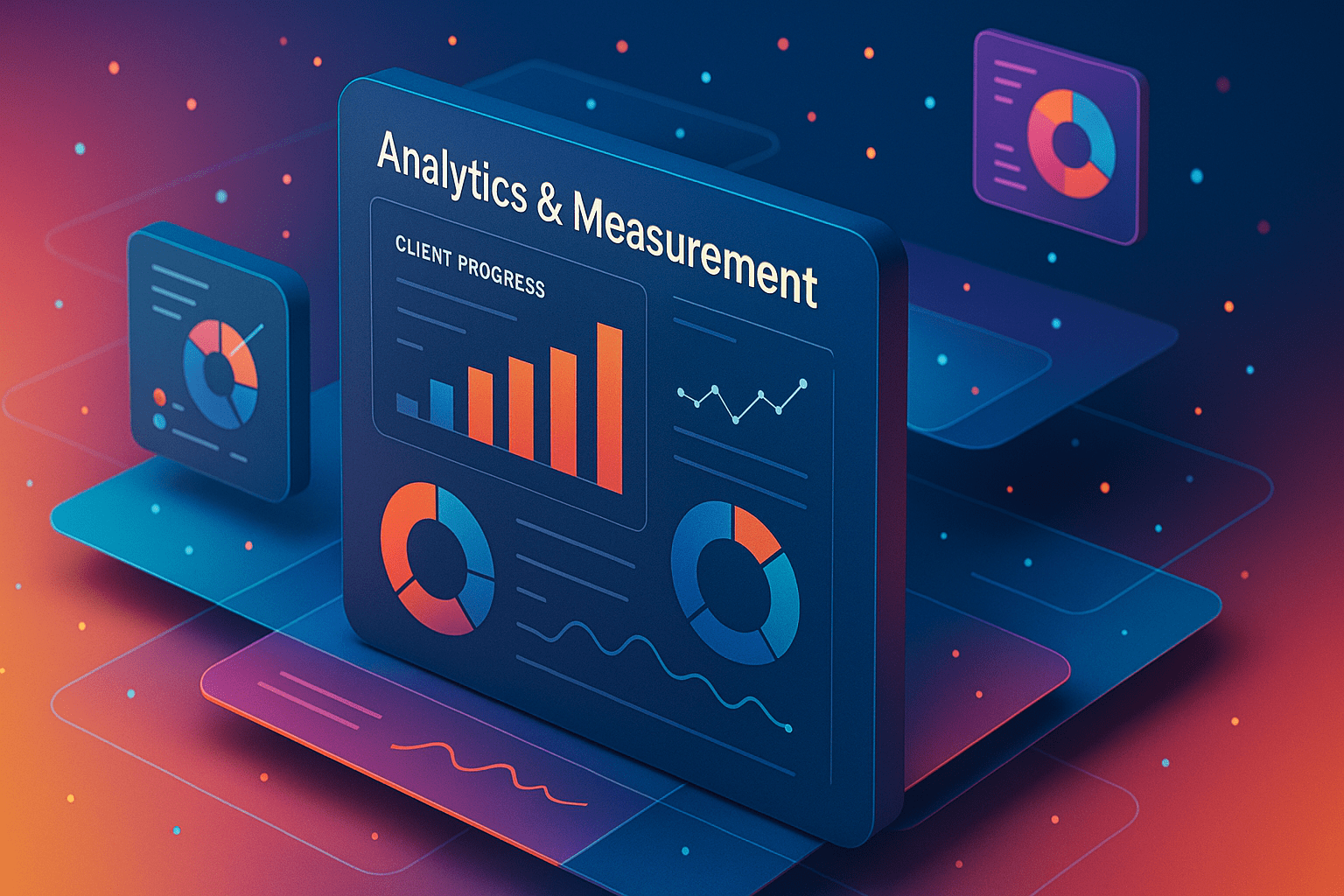
Phase 1: Discovery & Goals
Every successful analytics project begins with clarity about what you're trying to achieve. During discovery, you identify the specific questions your analytics system must answer and the decisions those answers will inform. For personal trainers, common questions include: Which marketing channels deliver clients who stay longest? What consultation-to-close rate indicates a healthy sales process? How do different pricing structures impact client lifetime value?
This phase also uncovers constraints—technical limitations of your current systems, budget realities, team capabilities, and timeline pressures. Understanding constraints upfront prevents scope creep and ensures your analytics solution fits your actual situation rather than some idealized scenario. You'll also define success metrics: What would make this analytics investment worthwhile? 20% improvement in lead quality? 15% better client retention? Clearer ROI visibility?
Key activities: Stakeholder interviews, current-state assessment, priority question identification, constraint documentation, and success criteria establishment. This typically requires 3-5 focused sessions with decision-makers and front-line staff who'll use the analytics.
Phase 2: Blueprint
With goals clarified, the blueprint phase designs your complete measurement system. This includes your measurement plan—a comprehensive document that specifies exactly what events to track, what properties to capture, how to categorize data, and what reports to build. For personal trainers, your measurement plan might include tracking consultation bookings (with source, consultation type, and trainer assigned), package purchases (with package type, price point, and payment method), session completions (with client ID, trainer, and session type), and retention milestones (30-day, 90-day, 6-month marks).
The blueprint also maps your data architecture—how different systems connect, where data lives, and how it flows from collection to dashboard. You'll design your dashboard structure, plan your attribution model configuration, and document naming conventions. This upfront planning prevents expensive rebuilds later when you realize your initial setup doesn't capture critical information.
Technical considerations matter here: Will you use Google Analytics 4 exclusively or integrate with client management software? How will you handle PII in compliance with privacy regulations? What automation will reduce manual data entry? The blueprint answers these questions before you write a single line of code or configure any tracking.
Phase 3: Build & Launch
Implementation brings your blueprint to life. For personal trainers, this typically involves: configuring GA4 properties with custom events for your business model, setting up server-side tagging through Google Tag Manager, integrating booking and payment systems with your analytics platform, building Looker Studio dashboards that surface key metrics, and implementing quality assurance processes to verify tracking accuracy.
The build phase emphasizes progressive deployment rather than big-bang launches. You might start by implementing website tracking and basic conversion events, validate that data is flowing correctly, then add ecommerce tracking for package purchases, followed by integration with your booking system. This staged approach lets you catch and fix issues early rather than debugging a complex system all at once.
QA is non-negotiable. Before going live, test every event trigger, verify data appears correctly in your dashboards, confirm attribution is calculating as expected, and validate that privacy controls work properly. For personal trainers, test scenarios should include: booking a consultation through different channels, purchasing various package types, completing sessions, and requesting program changes. Each scenario should produce accurate data throughout your analytics stack.
Phase 4: Optimize
Analytics isn't 'set it and forget it'—it's a continuous improvement process. The optimize phase establishes rhythms for reviewing data, identifying insights, and acting on what you learn. For personal trainers, this might include weekly performance reviews (How many leads this week? What's converting? Any unusual patterns?) and monthly deep dives (Which programs are most profitable? Where are we losing clients? What marketing tests should we run?).
Optimization also means refining your measurement system as your business evolves. When you launch a new service offering, you add tracking for it. When you identify a data gap, you configure new events. When a dashboard becomes cluttered, you redesign it for clarity. The goal is making your analytics more valuable over time, not just maintaining what you built initially.
The trainers who extract maximum value from analytics close the feedback loop: they review data regularly, generate hypotheses about improvements, test those changes, and measure results. This creates a compounding advantage where each cycle of measurement and optimization builds on previous learnings, steadily improving business performance.
Deliverables You'll Receive
A comprehensive analytics implementation for personal trainers produces several concrete deliverables that provide immediate value and ongoing utility.
Tracking Plan
Your tracking plan is the definitive guide to what gets measured and how. It documents every event (consultation_booked, package_purchased, session_completed), every property captured with those events (lead_source, package_type, client_id), and the business logic behind each measurement. This becomes the reference document that ensures consistent tracking as your team grows and your systems evolve. The tracking plan prevents drift where different people interpret metrics differently or track events inconsistently.
GA4 and Server-Side Setup
You receive a fully configured Google Analytics 4 property tailored to personal training businesses, with custom events matching your client journey, conversion tracking for your specific goals, and audience segments for your marketing needs. Server-side tagging implementation ensures data accuracy despite browser limitations. All configuration is documented so you understand what's set up and why, enabling you to maintain and extend the system as needed.
Dashboards
Custom Looker Studio dashboards give you instant visibility into business performance. A typical dashboard suite for personal trainers includes: an Executive Overview showing revenue, client count, and key trends; a Marketing Performance dashboard breaking down lead sources, conversion rates, and acquisition costs; a Client Health dashboard tracking retention, satisfaction, and at-risk indicators; and an Operations dashboard revealing utilization rates, scheduling efficiency, and capacity planning insights. These dashboards update automatically and are accessible from any device.
Attribution Model Settings
Your attribution model configuration reveals which touchpoints deserve credit for client acquisition. You receive documentation explaining your attribution methodology, how to interpret attribution reports, and when to adjust the model as your marketing mix changes. This deliverable transforms vague notions of 'marketing that works' into precise understanding of which channels and campaigns drive real business results.
Best Practices for Personal Trainer Analytics Success
Following these proven practices maximizes the value of your analytics investment and helps you avoid common pitfalls that undermine measurement initiatives.
Prioritize Highest-Impact Pages and Flows First
Don't try to track everything simultaneously. Start with the pages and user flows that matter most to your business: your homepage, consultation booking page, program pricing page, and the checkout process. Get tracking perfect on these critical paths before expanding to secondary pages. This 80/20 approach delivers most of the value with a fraction of the effort, letting you act on insights quickly rather than waiting months for comprehensive tracking.
Pair Creative with Measurement
Every marketing asset should have a defined KPI. That Instagram post? Track link clicks and consultation bookings it generates. That YouTube workout video? Measure channel subscriptions and website visits from viewers. That email newsletter? Monitor open rates, click rates, and subsequent program purchases. When creative and measurement work in tandem, you learn what resonates with your audience and can double down on effective content while eliminating what doesn't work.
Use Templates and Systems to Scale
Create repeatable processes for common analytics tasks. Build a campaign tracking spreadsheet that ensures every marketing initiative gets properly tagged. Develop a dashboard template you replicate for each new program launch. Document your monthly review process so anyone on the team can run it. Systemization transforms analytics from specialized knowledge into organizational capability, making measurement sustainable as your training business grows.
Close the Loop with Regular Reviews
Schedule non-negotiable time for data review. Weekly check-ins catch problems early and keep you aware of current performance. Quarterly deep reviews identify strategic trends and inform major decisions about service offerings, pricing, and market positioning. The discipline of regular review cadences ensures analytics actually influences decisions rather than sitting unused in dashboards that nobody checks. Block this time on your calendar and treat it as seriously as client sessions.
Industry-Specific Tips for Personal Trainers
Personal training has unique characteristics that require specialized analytics approaches. These industry-specific strategies help you extract maximum value from your measurement systems.
Map Search Intent to Buyer Stages
People searching 'best personal trainer near me' are in a different buying stage than those searching 'how to lose 20 pounds' or 'what is progressive overload.' Your analytics should segment traffic by search intent and track how each segment progresses through your funnel. This reveals where to focus content creation (early-stage educational content for awareness, comparison content for consideration, transformation stories for decision) and lets you optimize each funnel stage independently rather than treating all visitors identically.
Use Social Proof Early in the Journey
Track how exposure to different types of social proof (before/after photos, video testimonials, success metrics, certification badges) influences consultation booking rates and package purchases. You might discover that visitors who view transformation photos book consultations 40% more often, or that seeing specific credential badges increases average package value by 25%. These insights guide what proof points to emphasize and where to place them for maximum impact.
Measure Against a Single Source of Truth
Personal trainers often juggle multiple platforms: social media analytics, booking software reports, payment processor data, and email marketing metrics. Consolidate everything into one dashboard that becomes your definitive reference. When someone asks 'How many new clients did we get last month?' everyone references the same number from the same source. This eliminates conflicting reports and the wasted time reconciling discrepancies across systems.
Ship Small, Test Fast, Keep Compounding Wins
Rather than massive overhauls, make incremental improvements guided by data. Test a new consultation question this week and measure how it affects close rates. Try a different call-to-action on your pricing page next week and track conversion changes. Adjust your Instagram posting schedule and monitor engagement patterns. Each small test teaches you something, and small wins compound into major advantages over time. The trainer who runs 52 tests per year (one weekly) learns exponentially more than the trainer who makes two big changes annually.
Getting Started with Your Analytics Implementation
Beginning your analytics journey requires some upfront preparation to ensure success. Start by auditing your current state: What data are you already collecting? What systems do you use? What questions can't you answer today? This assessment reveals your starting point and helps prioritize what to build first.
Next, secure stakeholder buy-in by connecting analytics to business goals people care about. Frame analytics not as a technical project but as a path to concrete outcomes: higher client retention, lower acquisition costs, better program results, or smoother operations. When decision-makers understand the business impact, they'll support the time and resource investment required.
Consider your team's analytics literacy. Will you need training on dashboard interpretation? Should you hire or contract specialized expertise for implementation? Who owns ongoing optimization? Addressing capability gaps early prevents analytics from becoming shelfware that nobody uses effectively. The most sophisticated tracking setup delivers zero value if your team doesn't know how to act on the insights it surfaces.
Finally, embrace iteration. Your first dashboard won't be perfect. Your initial tracking plan will miss some events. Your attribution model will need refinement. This is normal and expected. The goal is progress, not perfection. Launch something useful quickly, learn from using it, and improve continuously. The personal trainers winning with analytics in 2026 aren't the ones who built the perfect system—they're the ones who started measuring, learned from their data, and got better at analytics month after month.
Frequently Asked Questions
Let’s level up your Personal Trainers business
Need services that actually move the needle for Personal Trainers? See our approach, pricing, and timelines—then book a quick call.
Additional Resources
- Schedule a Strategy Call
Book a complimentary 30-minute consultation to discuss your personal training business goals, current analytics challenges, and discover how measurement systems can unlock growth and improve client outcomes.
- View Our Portfolio
Explore real-world analytics implementations and dashboard designs we've built for personal trainers and fitness professionals. See case studies showcasing measurable business improvements from data-driven decision making.
- Free Analytics Tools
Access our collection of free calculators, templates, and resources including tracking plan worksheets, dashboard templates, and client retention calculators designed specifically for personal training businesses.
Related Reading
Transform your personal training business with powerful analytics & measurement strategies. Get proven frameworks, KPIs, and tools to track what matters 💪🎯

Transform your SaaS startup's data into actionable insights. Expert analytics & measurement setup with GA4, attribution modeling, and revenue-focused dashboards.
🚀 Transform your property management business with data-driven analytics & measurement. Proven strategies for tracking performance, optimizing operations, and maximizing ROI with actionable insights.