Auto Repair E-commerce Development: Complete 2026 Strategy Guide
by Eric Barker · October 31, 2025

Smart, fast, and measurable. Here's how e-commerce development helps Auto Repair win.
The auto repair industry is experiencing a digital transformation that's reshaping how shops connect with customers and generate revenue. As vehicle complexity increases and consumer expectations shift toward instant access and transparent pricing, traditional walk-in-only business models are leaving significant revenue on the table. Modern auto repair shops need robust e-commerce platforms that handle everything from parts ordering and service booking to diagnostic consultations and membership programs.
What makes e-commerce development uniquely challenging for auto repair shops is the technical precision required. Unlike retail fashion or consumer electronics, auto parts require exact vehicle compatibility matching, detailed specification sheets, and integration with inventory management systems that track thousands of SKUs across multiple suppliers. Add service scheduling, mobile responsiveness for customers researching on-site, and payment processing for both retail and commercial accounts, and you're looking at a sophisticated digital ecosystem that demands specialized development expertise tailored to automotive workflows.
Why Auto Repair Shops Need Specialized E-commerce Solutions
Generic e-commerce platforms fall short for auto repair businesses because they lack the specialized functionality that automotive customers expect. When a vehicle owner searches for brake pads, they need year-make-model filtering that guarantees fitment accuracy, not generic product categories. Commercial fleet managers require bulk ordering capabilities, NET payment terms, and integration with their procurement systems—features absent from standard online store templates.
The stakes are particularly high in auto repair e-commerce. A wrong part recommendation doesn't just mean a return—it means a vehicle off the road, a frustrated customer, potential safety issues, and damage to your shop's reputation. This is why purpose-built e-commerce development for auto repair shops incorporates:
- VIN-based product matching: Decode vehicle identification numbers to display only compatible parts and services
- Real-time inventory synchronization: Connect your e-commerce platform with supplier APIs and shop management software to prevent overselling
- Service appointment integration: Allow customers to book appointments alongside parts purchases, with automatic calendar blocking
- Tiered pricing structures: Support retail, wholesale, fleet, and loyalty member pricing within a single platform
- Mobile-first diagnostics: Enable customers to upload photos or describe issues for pre-appointment consultations
According to recent industry data, auto repair shops with optimized e-commerce platforms see 23-37% higher average transaction values compared to phone-only ordering. The reason? Digital platforms enable effortless upselling through intelligent product recommendations, bundle suggestions, and transparent pricing that builds customer confidence before they reach the checkout.
Core Components of High-Converting Auto Repair E-commerce Platforms
Building an e-commerce presence that actually drives revenue for your auto repair shop requires more than just listing products online. The most successful implementations combine strategic architecture, technical excellence, and deep understanding of automotive customer behavior. Here's what separates performance-driven platforms from digital brochures:
Product Detail Pages That Convert Browsers Into Buyers
Your product detail pages (PDPs) are the frontline of your digital sales operation. In the auto repair space, these pages must balance technical specifications with accessibility for non-mechanic customers. Effective PDPs include:
- Visual compatibility indicators: Show exactly where the part goes on the vehicle with annotated diagrams or exploded views
- Installation difficulty ratings: Help DIY customers assess whether they need professional installation, creating service appointment opportunities
- Cross-reference numbers: Include OEM part numbers, competitor equivalents, and supersession information for professional buyers
- Trust signals: Display warranty information, return policies, and customer reviews prominently above the fold
- Dynamic pricing: Show retail pricing alongside your shop's price with savings calculations that justify the purchase
The key insight: auto repair customers buy on confidence, not just price. Your PDPs should eliminate every possible objection before customers reach the add-to-cart button.
Checkout Optimization for Maximum Completion Rates
Cart abandonment rates in automotive e-commerce average 68-73%, significantly higher than general retail. The culprits? Unexpected shipping costs, complex account creation requirements, and uncertainty about delivery timelines. Address these friction points with:
- Guest checkout options: Reduce form fields to absolute essentials—name, contact, payment, and delivery preference
- Progressive shipping calculation: Display shipping costs early in the cart, not as a surprise at final checkout
- In-store pickup incentives: Offer discounts or perks for local pickup to reduce fulfillment costs while driving foot traffic
- Saved vehicle profiles: Allow returning customers to select from previously entered vehicles, eliminating re-entry
- Multiple payment methods: Accept credit cards, PayPal, Affirm financing, and commercial account charging
One optimization that consistently improves conversion: displaying a clear order summary sidebar throughout the checkout process. Customers in the automotive space often comparison shop across multiple tabs—keeping your total, savings, and delivery date visible reduces cognitive load and prevents second-guessing.

Catalog Architecture and Search Functionality
The average auto repair shop stocks or can source 15,000 to 50,000+ individual parts and fluids. Without intelligent catalog architecture, customers drown in options and abandon their search. Your e-commerce platform needs multi-dimensional filtering that reflects how customers actually think:
| Search Approach | Customer Type | Required Functionality |
|---|---|---|
| Vehicle-First | DIY owners, fleet managers | Year/Make/Model/Trim dropdowns, VIN decoder integration |
| Symptom-Based | Non-technical customers | 'My car is...' guided navigation, symptom-to-product mapping |
| Part Number Direct | Professional mechanics, wholesale buyers | Cross-reference search, OEM number matching, bulk import tools |
| Category Browse | Maintenance shoppers | Intuitive taxonomy (Brakes → Front → Pads → Ceramic), visual navigation |
Performance consideration: Catalog pages with 50+ products require lazy loading and pagination strategies to maintain sub-2-second load times. Implement progressive image loading, prioritize above-the-fold content, and use CDN distribution for product images to prevent catalog browsing from becoming a frustrating waiting game.
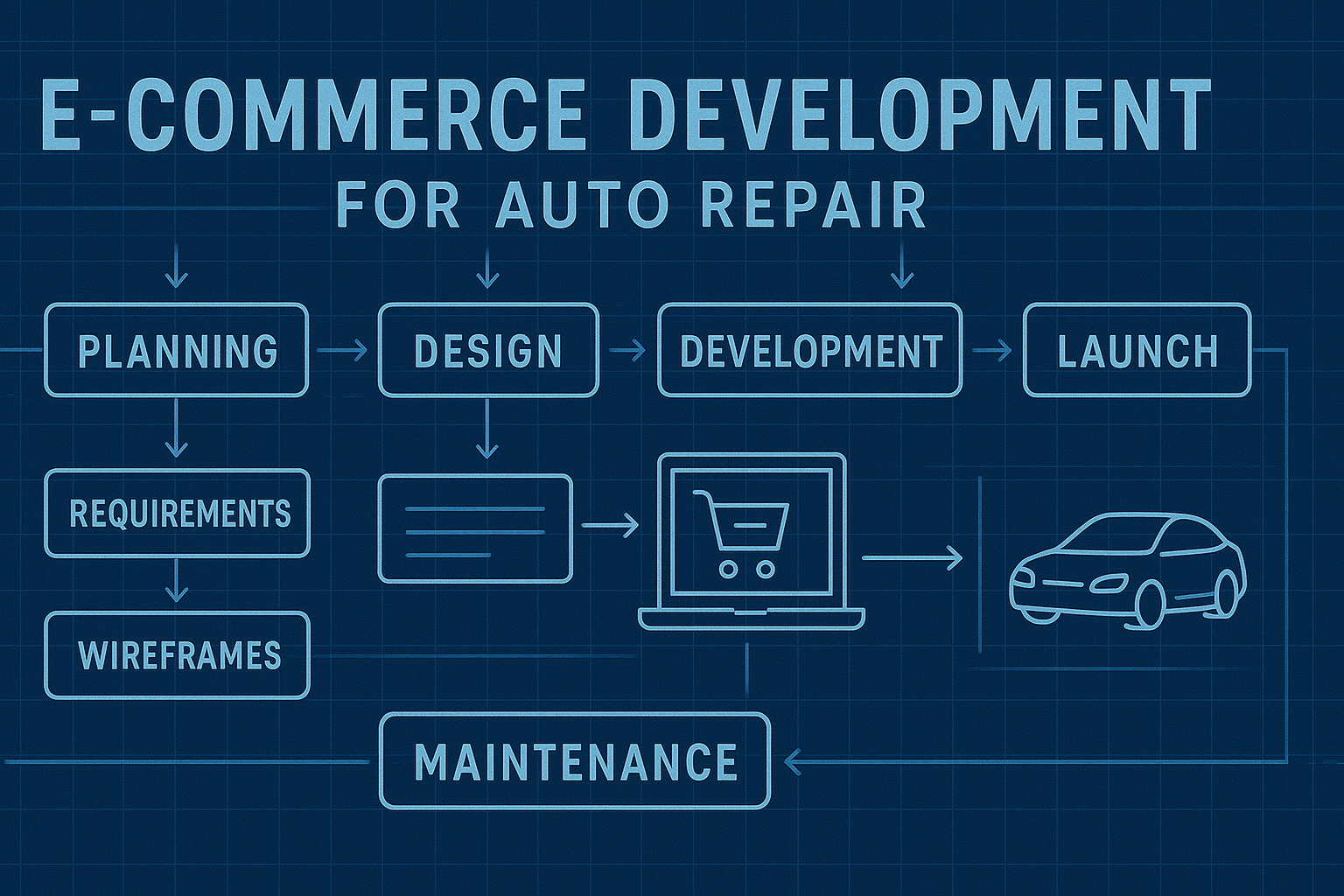
Strategic Implementation: The Four-Phase E-commerce Development Process
Successful auto repair e-commerce projects follow a structured methodology that balances speed-to-market with long-term scalability. Rushing into development without strategic planning leads to costly rebuilds; over-planning delays revenue generation. Here's the proven four-phase approach:
Phase 1: Discovery and Goal Alignment (Week 1-2)
This foundation phase prevents the most common e-commerce failure: building the wrong solution efficiently. Your development team should work with your shop leadership to document:
- Revenue targets and timeline: What does success look like in 3 months, 6 months, and 12 months? Define specific metrics like average order value, monthly transaction count, and customer acquisition cost.
- Customer segmentation: Who are you building for? DIY customers require different features than fleet managers or wholesale accounts.
- Technical constraints: What existing systems must integrate? Shop management software, supplier APIs, accounting platforms, and CRM tools all impact architecture decisions.
- Competitive analysis: What are successful competitors doing well? Where are gaps you can exploit?
- Content readiness: Do you have professional product photography, detailed descriptions, and accurate specifications? Content gaps derail launches.
Deliverable: A comprehensive project brief that serves as the single source of truth for all subsequent decisions, including technical specifications, success metrics, integration requirements, and launch criteria.
Phase 2: Blueprint and Architecture Design (Week 2-3)
With goals clarified, your development team designs the information architecture, user flows, and technical stack that will power your e-commerce platform. Key decisions made during this phase include:
- Platform selection: Custom-built versus enterprise platforms like Shopify Plus, BigCommerce, or WooCommerce with automotive plugins
- Integration strategy: API-first architecture that connects your e-commerce front-end with inventory, pricing, and customer data sources
- Mobile-first wireframing: Screen-by-screen mockups showing how customers navigate from vehicle selection through checkout
- Data migration planning: How existing customer data, order history, and product catalogs transfer to the new platform
- Analytics instrumentation: Which events and conversions get tracked, how attribution works, and what reports stakeholders need
Critical consideration: Build for iteration, not perfection. Your initial launch should include core functionality that generates revenue immediately—vehicle lookup, core parts catalog, and checkout. Secondary features like wish lists, comparison tools, and advanced filtering can be phased in based on customer behavior data.
Phase 3: Development, QA, and Launch Preparation (Week 4-7)
This is where strategy becomes tangible software. Development typically proceeds in parallel tracks: front-end UI/UX build-out, back-end integration development, and content population. For auto repair shops, the integration work often proves most complex:
- Supplier API connections: Real-time inventory checks, pricing updates, and order transmission to parts distributors
- Shop management system sync: Bidirectional data flow between your e-commerce platform and tools like Mitchell, Shop-Ware, or Tekmetric
- Payment gateway configuration: PCI-compliant credit card processing, ACH for commercial accounts, and buy-now-pay-later integrations
- Tax calculation automation: Location-based sales tax for parts and services, exemption certificate handling for wholesale buyers
QA testing for auto repair e-commerce goes beyond standard functional testing. You must validate fitment accuracy across hundreds of vehicle configurations, test checkout flows with various payment methods and account types, confirm inventory synchronization under load, and verify mobile responsiveness on devices with slower connections (many customers browse while in parking lots or service bays).
Pre-launch checklist essentials:
- Confirmed SSL certificate and secure payment processing
- Google Analytics 4 and conversion tracking fully configured
- Email automation triggered for order confirmation, shipping updates, and abandoned cart recovery
- Staff training completed on order management and customer support workflows
- Soft launch to test group (existing customers, staff family) for real-world validation
Phase 4: Optimization and Continuous Improvement (Ongoing)
Launch day is the beginning, not the end. The most successful auto repair e-commerce operations treat their platforms as living systems that evolve based on data. Establish these optimization rhythms:
- Weekly performance reviews: Analyze conversion rates, cart abandonment points, top-selling products, and search queries that returned no results
- Monthly A/B testing: Test variations of product page layouts, checkout flows, promotional offers, and navigation structures
- Quarterly feature releases: Based on customer feedback and behavioral data, prioritize and implement new functionality in planned sprints
- Annual strategic assessment: Revisit original goals, evaluate platform performance against competitors, consider technology upgrades or migrations
One often-overlooked optimization: search query analysis. Customers tell you exactly what they want when they type in your search box. If 'oil change kit Camry' returns no results because you categorize these items separately, you're losing sales. Monthly search analysis identifies these gaps and guides merchandising improvements.

Merchandising Strategies That Drive Revenue for Auto Repair Shops
E-commerce merchandising in the auto repair space differs dramatically from typical retail. Your customers have specific vehicle needs and narrow compatibility requirements, but that doesn't mean upselling and cross-selling are off the table. Intelligent merchandising increases average order values while genuinely helping customers make better purchase decisions.
Bundling and Package Optimization
Auto repairs rarely require just one part. A brake job needs pads, rotors, and often fluid. An oil change requires a filter, drain plug gasket, and the correct quantity of oil. Create pre-configured bundles that offer slight discounts versus individual purchases while ensuring nothing gets forgotten:
- Complete service kits: 'Everything you need for a 60k mile service on your 2019 Honda Accord' bundles
- Upgrade paths: Show standard, premium, and performance options side-by-side with clear differentiation
- Frequently bought together: Algorithmic recommendations based on actual purchase patterns from your order history
- Preventive maintenance packages: Seasonal bundles like 'Winter Prep Kit' or 'Summer Road Trip Essentials'
Merchandising insight: Bundles priced at 5-10% discounts versus individual items perform best. Deeper discounts don't significantly improve bundle adoption but erode margins unnecessarily.
Personalization Based on Vehicle and Purchase History
Once a customer enters their vehicle information or makes a purchase, your platform knows valuable context. Use this data to create personalized homepage experiences, targeted email campaigns, and predictive maintenance reminders:
- If a customer bought brake pads 18 months ago, trigger an email: 'Time to check your brakes—shop pads for your Civic'
- When customers log in, show a garage page featuring their saved vehicles with quick-add buttons for common maintenance items
- For commercial accounts, display recently ordered items prominently with one-click reorder functionality
- Send seasonal reminders for services like coolant flushes, tire swaps, or air filter replacements based on vehicle age and mileage
The data opportunity: Every vehicle has a predictable maintenance schedule. Build these schedules into your platform to automate personalized reminders that drive repeat purchases without relying on customers to remember when service is due.
Performance Optimization for Large Automotive Catalogs
Page speed isn't just a Google ranking factor—it's a direct conversion influencer. Research shows that every 100ms improvement in load time increases conversion rates by 1-2% for e-commerce. When your catalog contains tens of thousands of parts with multiple images each, performance optimization becomes critical.
Technical Performance Strategies
Auto repair e-commerce platforms face unique performance challenges. Product pages often load multiple high-resolution images showing the part from different angles, fitment diagrams, installation instructions, and related products. Implement these optimizations:
- Responsive image serving: Deliver appropriately sized images based on device and viewport, not one-size-fits-all
- Lazy loading beyond the fold: Load initial content instantly; load below-scroll images and videos only when users approach them
- CDN distribution: Serve static assets from edge locations nearest to customers, reducing latency for image-heavy pages
- Database query optimization: Index vehicle fitment tables, cache frequent searches, and use database views for complex queries
- API response compression: Minimize data transfer between your front-end and inventory/pricing APIs
Performance benchmark: Target sub-2-second fully loaded times for product pages and sub-3-seconds for catalog pages. Mobile performance should match desktop—don't sacrifice speed for mobile users on cellular connections.
Scalability Architecture
Your e-commerce platform must handle traffic spikes without degradation. Black Friday promotions, seasonal rushes (back-to-school, winter prep), or viral social media mentions can 10x your normal traffic overnight. Architectural considerations for scalability:
- Horizontal scaling: Add server capacity dynamically based on load, not fixed infrastructure
- Caching layers: Serve frequently accessed pages from memory rather than regenerating on every request
- Async processing: Handle inventory checks, pricing updates, and order processing in background queues, not blocking the user interface
- Load testing: Simulate traffic at 5x and 10x normal load to identify bottlenecks before they impact customers
Analytics and Measurement: Making Data-Driven Decisions
Without proper analytics instrumentation, you're flying blind. The most sophisticated e-commerce platform delivers zero ROI if you can't measure what's working and what's failing. For auto repair shops, analytics must connect digital behavior to real-world revenue—online orders, in-store purchases after online research, and service appointments booked through the platform.
Essential Tracking and KPIs
Set up comprehensive tracking from day one. Retrofitting analytics after launch means lost baseline data and delayed optimization. Track these critical metrics:
| Metric Category | Key Indicators | Why It Matters |
|---|---|---|
| Acquisition | Traffic sources, new vs. returning visitors, cost per acquisition | Understand which marketing channels drive qualified traffic |
| Engagement | Pages per session, time on site, bounce rate by page type | Identify content that resonates versus pages that need improvement |
| Conversion | Add-to-cart rate, checkout start rate, purchase completion rate | Pinpoint exactly where customers drop out of the buying process |
| Revenue | Average order value, customer lifetime value, repeat purchase rate | Measure business impact and profitability of e-commerce operations |
| Product | Top sellers, zero-result searches, cart abandonment by product category | Guide inventory decisions and identify merchandising opportunities |
Attribution and Multi-Touch Analysis
Auto repair purchases rarely happen on first visit. Customers research, compare, maybe call with questions, then return to purchase. Last-click attribution misrepresents the customer journey by giving all credit to the final touchpoint. Implement multi-touch attribution to understand:
- Which initial touchpoints (blog content, SEO, social ads) start customer journeys
- How many interactions typically occur before purchase
- Which channels assist conversions versus drive final purchases
- The role of offline interactions (phone calls, in-person consultations) in digital conversion paths
Practical implementation: Use Google Analytics 4's data-driven attribution or dedicated automotive attribution platforms that connect online behavior with shop management system data to track the complete customer journey from digital discovery through in-shop service completion.
Industry-Specific Best Practices for Auto Repair E-commerce Success
Generic e-commerce advice fails in the auto repair context because the industry has unique dynamics. Apply these specialized practices to maximize your platform's effectiveness:
Map Content to Automotive Buyer Stages
Auto repair customers progress through distinct stages with different information needs:
- Problem identification: 'Why is my car making a grinding noise?' — Content: Diagnostic guides, symptom explainers, educational blog posts
- Solution research: 'Do I need new brake pads or rotors?' — Content: Comparison guides, service explainers, DIY vs. professional analysis
- Part selection: 'Which brake pads fit my 2018 Camry?' — Content: Product pages with detailed specs, reviews, fitment guarantees
- Purchase decision: 'Should I buy from this shop?' — Content: Pricing transparency, shipping/pickup options, warranty information, trust signals
- Post-purchase: 'How do I install these parts?' — Content: Installation guides, video tutorials, support contact options
Your e-commerce platform should serve customers at all five stages, not just the point-of-purchase moment.
Leverage Social Proof and Outcome Focus
Auto repair customers make purchase decisions based on trust and proven results. They're spending money to solve problems—delayed commutes, safety concerns, failing inspections. Your e-commerce content should emphasize outcomes over features:
- Before-and-after visuals: Show the problem the part solves, not just the part itself
- Customer review quantity: Parts with 50+ reviews convert 20-30% better than those with few reviews—incentivize review submission
- Expert recommendations: 'Our ASE-certified techs recommend this option for most customers' builds credibility
- Warranty prominence: Feature warranty length and coverage details above the fold on every PDP
- Installation difficulty ratings: Help customers self-select appropriate products based on skill level
Single Source of Truth Dashboard
Auto repair shops touch multiple systems daily—shop management software, parts ordering platforms, accounting tools, marketing channels. Your e-commerce analytics should feed into one unified dashboard that shows real-time business health:
- Today's online orders and revenue versus goals
- Week-to-date e-commerce contribution to total shop revenue
- Top-selling products and low-stock alerts
- Customer acquisition cost by channel
- Service appointments booked through the platform
- Active cart values (potential revenue if converted)
This dashboard becomes your morning briefing—a 30-second check that surfaces opportunities and problems requiring immediate attention.
Ship Small, Test Fast, Compound Wins
The most successful auto repair e-commerce operations don't wait for perfection. They launch with core functionality, then iterate based on customer behavior. This 'minimum viable platform' approach means:
- Launch with 20% of planned features that enable 80% of customer transactions
- Weekly improvement sprints addressing top friction points identified in analytics
- Monthly feature additions validated by customer requests and usage patterns
- Quarterly major enhancements based on competitive analysis and industry trends
Example: Rather than delaying launch until you've photographed every part, start with supplier images for 80% of products and invest photography budget in your 200 top sellers that drive most revenue. Add professional images to additional products based on sales velocity data.
Integration Ecosystem: Connecting Your Digital and Physical Operations
Your e-commerce platform shouldn't exist in isolation. The most powerful implementations connect digital transactions with shop floor operations through strategic integrations:
Shop Management System Bidirectional Sync
When an online order arrives, your technicians need instant visibility. When a customer visits your shop, staff need access to online order history. Integrate your e-commerce platform with shop management tools like:
- Mitchell 1 Manager SE: Two-way customer data, job history, and inventory sync
- Shop-Ware: Automatic work order creation from online service bookings
- Tekmetric: Customer communications bridging online and in-shop experiences
- AutoFluent: Digital vehicle inspections that generate parts recommendations for e-commerce upsell
The business impact: Reduce double-entry errors, accelerate order fulfillment, and create seamless customer experiences whether they interact with you online or in person.
Supplier and Distributor API Connections
Manual inventory management doesn't scale. Integrate directly with parts suppliers to enable:
- Real-time inventory checks: Show accurate availability before customers add to cart
- Automated pricing updates: Reflect supplier cost changes in your retail pricing instantly
- Electronic order transmission: Send orders directly to distributors without re-entry
- Shipment tracking: Provide customers with tracking numbers automatically when suppliers ship
Major distributors offering API access: NAPA, AutoZone B2B, O'Reilly Professional, Advance Auto Parts, and Worldpac. Implement at least two supplier integrations to provide product availability redundancy.
Mobile-First Considerations for Auto Repair E-commerce
Over 60% of auto repair e-commerce traffic comes from mobile devices, often from the shop parking lot or roadside as customers research issues. Mobile performance isn't optional—it's primary:
- Thumb-friendly navigation: Large tap targets, bottom-screen primary actions, minimal scrolling required
- Simplified forms: Autofill-enabled inputs, dropdown selectors over text entry, VIN barcode scanning
- Click-to-call prominence: Make phone numbers tappable throughout the experience for quick conversion
- Offline functionality: Cache recent searches and vehicle information so poor cellular connections don't break the experience
- Progressive web app capabilities: Enable 'add to home screen' for frequent customers, providing app-like experiences without app store friction
Mobile optimization example: Implement a sticky bottom bar on product pages with 'Add to Cart' and 'Call to Order' options always visible. This prevents customers from scrolling back up to find purchase options—reducing friction equals higher conversions.
Security and Compliance for Automotive E-commerce
Handling customer payment information and personal data requires robust security practices and regulatory compliance. Auto repair shops face additional considerations because commercial accounts often involve business tax IDs and credit terms:
Essential Security Measures
- PCI DSS compliance: Never store credit card numbers on your servers—use tokenization through your payment gateway
- SSL/TLS encryption: Ensure all pages, not just checkout, use HTTPS to protect customer data in transit
- Regular security audits: Quarterly vulnerability scans and annual penetration testing
- Two-factor authentication: Require for administrative access and optionally offer for customer accounts
- Data backup automation: Daily encrypted backups with tested restoration procedures
Privacy and Compliance
Modern privacy regulations impact how you collect and use customer data:
- CCPA compliance (California): Provide data deletion requests handling, opt-out mechanisms for data selling
- GDPR considerations: Even US-based shops need GDPR compliance if selling to EU customers
- Clear privacy policies: Explain what data you collect, how it's used, and who it's shared with
- Marketing consent: Explicit opt-in for email marketing rather than pre-checked boxes
ROI Modeling and Financial Projections
E-commerce development requires upfront investment. Build a business case that quantifies expected returns based on realistic projections grounded in industry benchmarks:
Typical Investment Ranges
- Platform setup and design: $15,000 -$45,000 depending on customization level
- Integration development: $8,000 - $25,000 for shop management and supplier API connections
- Content creation: $5,000 - $15,000 for product photography, descriptions, and educational content
- Ongoing maintenance: $1,500 - $4,000 monthly for hosting, updates, support, and optimization
Revenue Projection Framework
Model your expected returns using these conservative assumptions:
- Year 1: E-commerce contributes 8-15% of total shop revenue as customers discover and adopt the platform
- Year 2: Growth to 15-25% as repeat purchase behavior establishes and SEO gains traction
- Year 3+: Mature platforms reach 25-40% contribution, with some shops exceeding 50% for parts sales
Example calculation: A shop generating $1.2M annually with $400K in parts sales could realistically expect $48K-$60K in online parts revenue within year one (12-15% of parts revenue), growing to $100K-$160K by year three. With proper execution, the platform pays for itself within 6-12 months.
Future-Proofing Your Auto Repair E-commerce Platform
Technology evolves rapidly. Build your platform with adaptability in mind to avoid costly rebuilds as customer expectations and technical capabilities advance:
Emerging Trends to Consider
- AI-powered diagnostics: Customers upload videos or photos of issues; AI suggests likely problems and relevant parts
- AR visualization: Augmented reality showing how parts look installed on specific vehicles before purchase
- Voice commerce: 'Alexa, reorder oil and filter for my truck' integration with voice assistants
- Subscription services: Monthly plans for routine maintenance items (oil, filters, wiper blades) with automatic delivery/pickup reminders
- Blockchain verification: Immutable records proving parts authenticity for high-value or safety-critical components
While not all trends warrant immediate implementation, your platform architecture should accommodate future additions through modular design and API-first development approaches.
Sustainability and Environmental Considerations
Increasingly, customers factor environmental impact into purchasing decisions. Position your e-commerce platform to highlight sustainability:
- Remanufactured parts promotion: Feature rebuilt components as eco-friendly alternatives with clear quality assurances
- Core return logistics: Streamline the process for customers to return old parts for rebuilding
- Carbon-neutral shipping options: Partner with carriers offering offset programs and give customers the choice
- Packaging optimization: Source recycled materials and right-size packaging to reduce waste
- Electric vehicle readiness: As EV adoption accelerates, ensure your catalog and expertise expand to cover electric drivetrain components
Common Pitfalls to Avoid in Auto Repair E-commerce Development
Learn from others' mistakes rather than repeating them. These frequent missteps derail auto repair e-commerce projects:
Technical Pitfalls
- Inadequate fitment data: Launching with incomplete vehicle compatibility information creates customer frustration and return headaches. Verify fitment data completeness before launch.
- Neglecting mobile performance: Designing for desktop first and treating mobile as an afterthought results in poor mobile conversion rates. Always prioritize mobile.
- Over-complicating checkout: Requiring account creation, requesting unnecessary information, or hiding shipping costs until final steps kills conversions.
- Weak search functionality: Generic product search that doesn't understand automotive terminology or part number variations frustrates professional buyers.
- Integration gaps: Launching without shop management system integration creates double-entry work that staff resent and customers notice through delayed order processing.
Strategic Pitfalls
- Launching with incomplete catalog: Better to launch with 500 well-merchandised products than 5,000 poorly documented ones. Start focused, expand methodically.
- Ignoring customer service: E-commerce doesn't eliminate the need for human support—budget for phone, email, and chat support resources.
- Set-it-and-forget-it mentality: Platforms require ongoing optimization, content updates, and technical maintenance. Plan for continuous improvement, not one-time project completion.
- Unrealistic traffic expectations: Building the platform doesn't automatically generate visitors. Budget for SEO, advertising, and promotional activities to drive awareness.
- Pricing disconnects: Online prices drastically different from in-shop pricing creates customer confusion and staff friction. Maintain pricing consistency across channels.
Building Your E-commerce Team and Skill Sets
Successful e-commerce operations require diverse skill sets beyond traditional auto repair expertise. Whether hiring, training existing staff, or outsourcing, ensure these capabilities:
Required Roles and Responsibilities
- E-commerce manager: Owns platform strategy, monitors KPIs, coordinates optimization efforts, manages vendor relationships
- Content specialist: Creates product descriptions, photographs parts, develops educational content, maintains catalog accuracy
- Digital marketer: Drives traffic through SEO, paid advertising, email campaigns, and social media promotion
- Customer support: Handles pre-sales questions, order issues, returns processing, and feedback collection
- Technical administrator: Manages platform updates, troubleshoots integration issues, ensures security compliance
For smaller shops, one person may wear multiple hats, but clearly define ownership for each function to prevent critical tasks from falling through cracks.
Measuring Long-Term Success Beyond Revenue
While revenue metrics matter most, track these secondary indicators of platform health that predict sustained success:
- Customer retention rate: Percentage of customers making repeat purchases within 12 months—target 40%+ for healthy operations
- Net Promoter Score (NPS): Survey customers post-purchase; scores above 50 indicate strong satisfaction and referral potential
- Search rankings improvement: Track position changes for target keywords monthly; rising rankings compound traffic growth
- Average order value trends: Growing AOV indicates successful upselling and bundling strategies
- Time-to-fulfillment: Days between order placement and customer receipt; faster fulfillment drives satisfaction and repeat business
- Support ticket volume: Decreasing support contacts per order suggests improving platform usability and documentation
Create a quarterly business review examining these metrics alongside revenue performance to identify opportunities and course-correct before small issues become major problems.
Frequently Asked Questions
Let’s level up your Auto Repair business
Need services that actually move the needle for Auto Repair? See our approach, pricing, and timelines—then book a quick call.
Additional Resources
- Schedule Your Strategy Session
Book a 30-minute consultation to discuss your auto repair shop's e-commerce goals. We'll review your current setup, identify quick wins, and outline a custom development roadmap with transparent pricing and timeline estimates.
- View Our E-commerce Portfolio
Explore case studies and live examples of auto repair e-commerce platforms we've built. See conversion rates, technical implementations, and results-driven design strategies across independent shops and multi-location operations.
- Access Free E-commerce Tools
Download our free auto repair e-commerce toolkit including conversion rate calculators, product page templates, checkout optimization checklists, and analytics setup guides. No registration required—instant access to proven resources.
Related Reading

Transform your salon/spa with expert e-commerce development! ⚡ Custom platforms, booking integration & revenue optimization. Get pricing inside 💡

Transform your law firm with strategic e-commerce development. Expert platform design, payment integration, and conversion optimization for legal services and products.

Transform your family law practice with tailored e-commerce development. Streamline client onboarding, secure payments, and service delivery. See packages and implementation roadmap.