E-commerce Development for Family Law Firms: Complete 2026 Implementation Guide
by Eric Barker · November 4, 2025
Smart, fast, and measurable. Here's how e-commerce development helps Family Law win.
Family law practices face a unique challenge in 2026: clients expect Amazon-level convenience while navigating some of life's most sensitive moments. Traditional intake forms, manual payment processing, and fragmented service delivery create friction that costs firms thousands in lost revenue and untold hours in administrative overhead. Modern e-commerce development solves this disconnect by transforming how family law firms deliver services, collect payments, and scale their practice.
The stakes are high. Firms that embrace digital commerce infrastructure report 40-60% faster client onboarding, dramatically reduced administrative burden, and measurably higher client satisfaction scores. Meanwhile, practices clinging to outdated systems watch prospects abandon complicated intake processes or choose competitors offering seamless digital experiences. E-commerce development isn't about selling products—it's about creating frictionless pathways for clients to access legal services when they need them most, with payment structures that match modern expectations and security standards that protect sensitive family data.
Why Family Law Firms Need E-commerce Development
Family law operates in a uniquely sensitive space where trust, confidentiality, and accessibility determine client acquisition and retention. Traditional practice management systems weren't built for modern client expectations—prospects researching divorce attorneys at midnight need immediate access to service options, transparent pricing, and secure engagement pathways. E-commerce development bridges this gap.
The modern family law client journey looks like this:
- Discovery phase: Late-night searches during emotional crisis moments
- Evaluation phase: Comparing multiple firms based on service clarity and process transparency
- Decision phase: Choosing firms that offer immediate, secure engagement options
- Engagement phase: Expecting seamless payment, document sharing, and communication
E-commerce infrastructure directly addresses each stage. Prospective clients can review service packages, understand pricing structures, securely pay retainers, upload confidential documents, and schedule consultations—all without business-hours phone tag or email delays. This isn't about replacing human interaction; it's about removing friction from administrative tasks so attorneys focus on legal strategy while clients experience professional, efficient service delivery.
Security considerations are paramount. Family law involves highly sensitive data—financial disclosures, custody arrangements, domestic violence documentation, and personal communications. Proper e-commerce development includes PCI-DSS compliant payment processing, encrypted document transmission, secure client portals, and audit trails that satisfy bar association technology requirements. These protections build client confidence while shielding firms from liability.
Core Components of Family Law E-commerce Systems
Effective e-commerce development for family law practices requires several integrated components working in concert. Each element serves specific client and operational needs while contributing to a cohesive digital experience.
Service Package Pages (Product Detail Pages)
Clear service presentation is foundational. Family law clients need to understand what they're purchasing before committing. Well-designed service package pages include:
- Transparent scope definition: Exactly what's included in flat-fee divorce packages, hourly consultation blocks, or document review services
- Pricing clarity: Upfront costs, payment plan options, and what triggers additional fees
- Process timelines: Realistic expectations for case progression and attorney response times
- Trust indicators: Attorney credentials, client testimonials, success metrics, and bar certifications
- Comparison tools: Side-by-side package comparisons helping clients select appropriate service levels
High-performing service pages convert browsers into clients by anticipating questions and removing decision paralysis. Every element—from pricing tables to attorney bios—reinforces credibility while moving prospects toward engagement.
Secure Checkout and Payment Processing
Payment friction kills conversions. Family law e-commerce requires checkout flows that balance security, compliance, and user experience:
- Multiple payment methods: Credit cards, ACH transfers, payment plans, and trust account deposits
- IOLTA compliance: Proper handling of retainer funds per bar association rules
- Automated receipting: Immediate payment confirmation with detailed transaction records
- Saved payment methods: Secure tokenization for ongoing fees without re-entering card data
- Mobile optimization: Seamless payment experience across devices
Leading family law e-commerce systems integrate with practice management software, automatically updating client ledgers and triggering engagement workflows. This eliminates double-entry while maintaining financial accuracy.
Client Portal Integration
Post-purchase experience matters as much as checkout. Comprehensive client portals provide:
- Secure document exchange: Encrypted upload/download of financial statements, court filings, and correspondence
- Case status dashboards: Real-time visibility into filing dates, hearing schedules, and milestone completion
- Communication hub: Secure messaging with attorneys and staff, replacing insecure email
- Invoice and payment history: Transparent billing with ability to pay outstanding balances online
- Resource library: Relevant guides, court forms, and educational content
Portal adoption directly correlates with client satisfaction and reduces incoming calls and emails requesting status updates.

Service Bundling and Upsell Architecture
Strategic bundling increases average transaction value while genuinely serving client needs:
- Comprehensive packages: Uncontested divorce + parenting plan + property settlement bundled at value pricing
- Add-on services: Mediation support, financial expert consultations, or expedited filing options
- Subscription models: Monthly advisory retainers for ongoing custody or support modifications
- Client lifecycle offers: Post-divorce services like modification assistance or compliance monitoring
Ethical bundling requires clear scope definitions and easy unbundling options. The goal is meeting client needs efficiently, not artificially inflating fees.
Implementation Roadmap for Family Law E-commerce
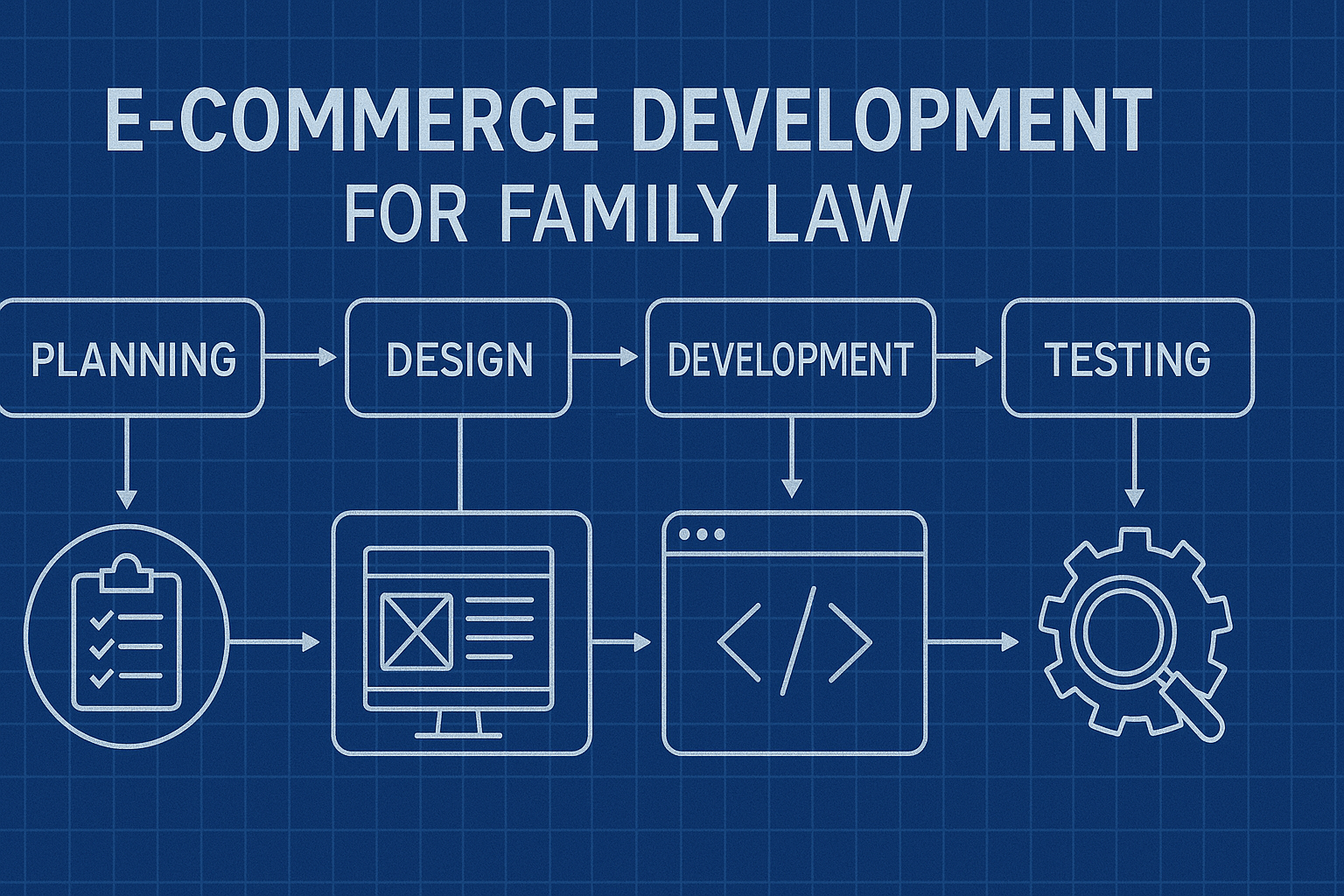
Successful e-commerce development follows a structured implementation approach that minimizes disruption while maximizing results. The process typically spans 6-12 weeks depending on practice size and technical complexity.
Phase 1: Discovery and Requirements Analysis (Week 1-2)
Foundation work determines project success. This phase includes:
- Service audit: Catalog all offerings, pricing models, and current engagement workflows
- Client journey mapping: Document how prospects currently discover, evaluate, and engage your firm
- Technology assessment: Evaluate existing practice management, accounting, and marketing systems
- Compliance review: Verify bar association technology requirements and IOLTA handling rules
- Success metrics definition: Establish baseline conversion rates, average transaction values, and client acquisition costs
This phase identifies friction points in current processes and opportunities for improvement. Common discoveries include unclear service descriptions, payment abandonment at form submission, and lack of after-hours engagement options.
Phase 2: Architecture and Design (Week 3-4)
Strategic planning translates requirements into actionable specifications:
- Platform selection: Choose between custom development, legal-specific platforms, or adapted e-commerce frameworks
- Information architecture: Structure service hierarchies, navigation, and user flows
- Payment integration design: Map payment processor connections, trust accounting logic, and receipt generation
- Security architecture: Design encryption, authentication, and access control systems
- Analytics framework: Plan tracking for conversion funnels, service popularity, and revenue attribution
Deliverables include wireframes, user flow diagrams, technical specifications, and content requirements. All stakeholders review and approve before development begins.
Phase 3: Development and Integration (Week 5-8)
Core build phase brings designs to life:
- Service page development: Build responsive templates with pricing tables, comparison tools, and conversion optimization
- Checkout implementation: Integrate payment processors with proper security and compliance measures
- Client portal creation: Develop secure document management, messaging, and case tracking features
- Practice management integration: Connect e-commerce system with existing case management and accounting software
- Automated workflow setup: Build email sequences, task creation, and notification systems
Iterative testing occurs throughout development. Staff and select clients preview functionality and provide feedback before broad release.
Phase 4: Testing, Training, and Launch (Week 9-10)
Pre-launch preparation ensures smooth rollout:
- Quality assurance testing: Comprehensive review of all user flows, payment scenarios, and edge cases
- Security audit: Vulnerability scanning, penetration testing, and compliance verification
- Staff training: Hands-on sessions covering new workflows, client support, and troubleshooting
- Content population: Finalize service descriptions, pricing, attorney bios, and educational resources
- Soft launch: Limited release to existing clients for real-world validation before public announcement
Launch isn't an endpoint—it's the beginning of continuous optimization based on user behavior and conversion data.
Phase 5: Optimization and Scaling (Ongoing)
Post-launch focus shifts to improvement:
- Conversion rate optimization: A/B test service page elements, pricing presentations, and checkout flows
- User experience refinement: Analyze heatmaps, session recordings, and support tickets to identify friction
- Feature expansion: Add capabilities based on client feedback and usage patterns
- Performance monitoring: Track site speed, uptime, and technical health
- Revenue analysis: Measure transaction values, package popularity, and lifetime client value
Monthly reviews assess performance against goals. Quarterly strategic planning sessions align e-commerce capabilities with evolving practice objectives.

Performance Metrics and Benchmarks
Measuring e-commerce success requires tracking metrics that directly connect digital performance to practice growth. Family law firms should monitor:
Conversion Metrics
- Service page conversion rate: Target 2-5% for cold traffic, 10-20% for warm referrals
- Checkout completion rate: Aim for 70%+ (abandonment below 30%)
- Average transaction value: Track across service types and acquisition channels
- Package mix: Monitor which bundles and price points perform best
Client Experience Metrics
- Time to first engagement: Measure from initial contact to retained client status
- Portal adoption rate: Percentage of clients actively using self-service features
- Support ticket volume: Should decrease as self-service improves
- Client satisfaction scores: Survey-based feedback on digital experience
Business Impact Metrics
- Client acquisition cost: Total marketing spend divided by new clients acquired
- Lifetime client value: Average revenue per client including initial and repeat services
- Administrative time savings: Hours reclaimed from manual intake and payment processing
- Revenue per attorney: Overall practice efficiency enabled by automation
Leading family law e-commerce implementations show 35-50% reduction in client onboarding time, 20-30% increase in average transaction value through strategic bundling, and 15-25% improvement in client acquisition cost as digital systems scale without proportional staff increases.
Common Implementation Challenges and Solutions
Family law e-commerce projects encounter predictable obstacles. Anticipating these challenges enables proactive mitigation:
Bar Association Technology Rules
Challenge: Navigating ethics opinions on online engagement, fee arrangements, and client communication security.
Solution: Early consultation with ethics counsel. Design systems with clear engagement disclaimers, proper conflict checking before payment acceptance, and communication tools meeting confidentiality standards.
Trust Account Compliance
Challenge: IOLTA rules require specific handling of advance fee deposits and proper segregation from earned fees.
Solution: Integrate payment processing with trust accounting software that automatically routes retainers to proper accounts and maintains detailed ledgers. Never commingle funds in e-commerce systems.
Service Scope Definition
Challenge: Family law matters resist simple productization—every case has unique elements.
Solution: Create tiered service packages covering common scenarios (uncontested divorce, basic custody agreement) with clear scope limitations. Offer consultation packages for complex situations requiring custom assessment. Transparency prevents scope creep.
Client Comfort with Digital Payments
Challenge: Some demographics hesitate to pay legal retainers online, especially for emotionally fraught matters.
Solution: Maintain alternative payment options (check, wire transfer) while emphasizing security measures. Display trust badges, security certifications, and clear privacy policies. Show real client testimonials about positive digital experiences.
Integration with Existing Systems
Challenge: Connecting e-commerce platforms with entrenched practice management, accounting, and marketing tools.
Solution: Prioritize platforms with robust APIs and pre-built integrations for popular legal software. Budget for custom middleware if needed. Accept that some manual data transfer may remain for edge cases.
Technology Stack Considerations
Family law e-commerce requires specific technology choices balancing functionality, security, and usability:
Platform Options
- Legal-specific platforms: Purpose-built systems like Lawmatics, CASEpeer, or CosmoLex with native e-commerce features. Pros: Compliance-aware, legal workflow optimization. Cons: Less flexible, potentially higher cost.
- E-commerce frameworks: WooCommerce, Shopify, or custom platforms adapted for services. Pros: Powerful commerce features, extensive integrations. Cons: Requires legal compliance customization.
- Custom development: Bespoke systems built specifically for your practice. Pros: Perfect fit for unique needs. Cons: Higher cost, longer timeline, ongoing maintenance burden.
Payment Processing
- Legal-specific processors: LawPay, Headnote, Confido Legal designed for trust accounting compliance
- General processors: Stripe, Square, Braintree with proper configuration for professional services
- Hybrid approach: Specialized processor for retainers and trust funds, general processor for earned fees and disbursements
Essential Integrations
- Practice management: Clio, MyCase, PracticePanther for case tracking and time entry
- Accounting: QuickBooks, Xero, or LeanLaw for financial management
- Document management: NetDocuments, iManage, or Dropbox Business for secure file storage
- Marketing automation: HubSpot, ActiveCampaign, or Mailchimp for lead nurturing
- Analytics: Google Analytics 4, Mixpanel, or Amplitude for behavioral tracking
Successful implementations prioritize interoperability over feature completeness. Better to have modest e-commerce features that integrate seamlessly than comprehensive capabilities requiring manual data transfer.
Content Strategy for Service Pages
E-commerce development provides the infrastructure, but conversion depends on compelling content that addresses client concerns while establishing attorney expertise:
Service Description Best Practices
- Lead with outcomes: 'Achieve fair custody arrangements' not 'We file motions'
- Explain the process: Step-by-step breakdown reduces anxiety and builds confidence
- Address common concerns: Cost, timeline, privacy, and complexity fears head-on
- Show qualifications: Relevant certifications, successful case examples, peer recognition
- Use plain language: Minimize legalese; write at 8th-grade reading level for accessibility
Pricing Presentation Strategies
- Tiered packages: Good/better/best structure helps clients self-select appropriate service level
- Transparent inclusions: Exactly what's covered at each price point, no surprises
- Payment plan options: Monthly installments make high-value services accessible
- Value anchoring: Compare package pricing to likely alternative costs (prolonged litigation, financial mistakes)
- Refund policies: Clear terms for unused retainer funds build trust
Trust-Building Elements
- Client testimonials: Specific outcome examples with permission (anonymized if sensitive)
- Case results: Aggregate success metrics and notable settlements (within ethics rules)
- Attorney credentials: Education, bar admissions, continuing education, and specializations
- Professional affiliations: American Academy of Matrimonial Lawyers, state bar family law sections
- Security certifications: Display badges for PCI compliance, SSL encryption, privacy frameworks
High-converting service pages answer the three critical client questions: Can you help me? Do I trust you? Can I afford you? Every content element serves one of these objectives.
Mobile Experience Optimization
Family law prospects increasingly research and engage via mobile devices—often during private moments outside business hours. Mobile optimization isn't optional:
Mobile-First Design Principles
- Touch-friendly interfaces: Large tap targets, ample spacing, no hover-dependent interactions
- Simplified forms: Minimal required fields, mobile keyboard optimization, autofill support
- One-hand usability: Critical actions accessible with thumb reach on standard phone sizes
- Fast load times: Compress images, minimize scripts, use mobile-optimized hosting
- Readable typography: Minimum 16px font sizes, adequate line height, sufficient contrast
Mobile Checkout Optimization
- Digital wallet support: Apple Pay, Google Pay, PayPal for frictionless payment
- Progress indicators: Show remaining steps in multi-page checkout flows
- Error prevention: Inline validation catches mistakes before submission
- Save and resume: Allow partial completion and return later
- Clear security indicators: Lock icons, trust badges sized for mobile screens
Test checkout flows on actual devices across iOS and Android. Emulators miss touch interaction nuances and performance realities of cellular connections.
Security and Privacy Considerations
Family law e-commerce handles extraordinarily sensitive information requiring defense-in-depth security:
Data Protection Measures
- End-to-end encryption: TLS 1.3 for data in transit, AES-256 for data at rest
- PCI DSS compliance: Never store raw credit card numbers; use tokenization
- Access controls: Role-based permissions, multi-factor authentication for staff and clients
- Regular security audits: Quarterly vulnerability scans and annual penetration testing
- Backup and recovery: Automated encrypted backups with tested restoration procedures
Privacy Framework
- Privacy policy: Clear disclosure of data collection, usage, retention, and sharing practices
- Consent management: Explicit opt-ins for communications and data processing
- Data minimization: Collect only information necessary for service delivery
- Retention policies: Define and enforce appropriate document and data lifecycle
- Breach response plan: Documented procedures for detection, containment, and notification
Compliance Maintenance
- Regular training: Staff education on security protocols and threat recognition
- Vendor management: Audit third-party service providers for security practices
- Incident monitoring: Log analysis and anomaly detection for unauthorized access attempts
- Update protocols: Timely patching of platforms, plugins, and dependencies
Security isn't a launch checkbox—it's an ongoing operational requirement. Budget for continuous monitoring and improvement.
Marketing Integration and Acquisition Strategy
E-commerce infrastructure enables sophisticated marketing that was previously impossible for family law practices:
Digital Advertising Optimization
- Service-specific landing pages: Direct ad traffic to targeted pages matching search intent
- Conversion tracking: Accurate attribution from click to retained client
- Retargeting campaigns: Re-engage prospects who viewed services but didn't purchase
- Dynamic pricing tests: A/B test pricing presentations and payment plan offers
Content Marketing Integration
- Service-linked articles: Educational content with clear pathways to relevant service packages
- Lead magnets: Offer guides and checklists in exchange for email addresses, then nurture toward services
- Email sequences: Automated campaigns addressing objections and highlighting service benefits
- Webinars and workshops: Virtual education events culminating in service offers
Referral Program Digitization
- Unique referral links: Trackable URLs for other attorneys, mediators, and past clients
- Automated commission payments: System-triggered referral fees per agreement terms
- Referrer dashboards: Real-time visibility into referred clients and earned commissions
The key insight: e-commerce systems generate behavioral data that informs and optimizes marketing spend. Track which acquisition channels produce highest lifetime value clients, then allocate budget accordingly.
Scaling Considerations for Growing Practices
As family law practices expand, e-commerce systems must scale without becoming operational bottlenecks:
Multi-Attorney Operations
- Attorney assignment logic: Route clients to appropriate attorneys based on practice area, workload, or location
- Capacity management: Prevent over-booking through automated availability tracking
- Performance dashboards: Compare attorney productivity, conversion rates, and client satisfaction
Multi-Location Support
- Geographic routing: Direct clients to nearest office or appropriate jurisdiction
- Localized content: Jurisdiction-specific pricing, processes, and regulatory information
- Centralized versus distributed: Balance consistent branding with local market customization
Service Line Expansion
- Template systems: Rapidly deploy new service pages following proven structures
- Cross-sell automation: Recommend complementary services based on client situation
- Analytics comparison: Measure new service performance against established offerings
Plan for scale from initial implementation. Architecture decisions that work for solo practitioners often break when supporting 5-10 attorneys across multiple offices.
Future Trends in Legal E-commerce
Family law e-commerce continues evolving. Forward-thinking practices monitor emerging capabilities:
AI-Powered Personalization
Machine learning systems will increasingly customize service recommendations, pricing presentations, and content based on prospect behavior and demographics. Early implementations show 15-20% conversion improvements through intelligent personalization.
Voice and Chat Commerce
Conversational interfaces allow clients to explore services, check case status, and complete transactions via chat or voice assistants. Natural language processing makes legal services more accessible to those uncomfortable with traditional web forms.
Blockchain for Trust and Transparency
Distributed ledger technology may provide immutable records of payments, documents, and agreements—valuable for high-conflict cases where parties dispute chronology or documentation.
Subscription Legal Services
Ongoing advisory relationships delivered through subscription models provide predictable revenue while meeting client needs for continuous access during lengthy family law matters.
While adopting bleeding-edge technology isn't necessary, understanding directional trends helps future-proof investment decisions and prevents building systems that will require complete overhauls in 2-3 years.
Frequently Asked Questions
Let’s level up your Family Law business
Need services that actually move the needle for Family Law? See our approach, pricing, and timelines—then book a quick call.
Additional Resources
- Schedule Your E-commerce Strategy Session
Book a complimentary 30-minute consultation to discuss your family law practice's e-commerce needs. We'll review your current client acquisition process, identify friction points, and outline a customized implementation roadmap. Get transparent pricing, realistic timelines, and actionable recommendations—whether you work with us or not.
- View Our Family Law E-commerce Portfolio
Explore real-world examples of successful e-commerce implementations for family law practices. See service page designs, checkout flows, and client portal interfaces that drive measurable results. Review case studies showcasing conversion improvements, client satisfaction scores, and revenue growth achieved through strategic digital commerce development.
- Access Free Legal E-commerce Tools
Download our comprehensive toolkit for family law e-commerce planning. Resources include service package pricing calculator, conversion rate benchmark worksheet, security compliance checklist, and client journey mapping template. All tools are immediately usable and require no registration or commitment.
Related Reading

Transform your salon/spa with expert e-commerce development! ⚡ Custom platforms, booking integration & revenue optimization. Get pricing inside 💡
Transform your law firm with strategic e-commerce development. Expert platform design, payment integration, and conversion optimization for legal services and products.
Transform your auto repair shop with conversion-focused e-commerce development. Learn proven strategies for parts catalogs, booking systems, and customer retention in 2026.