Conversion Rate Optimization for Medical Clinics: Turn More Website Visitors Into Booked Appointments
by Eric Barker · November 8, 2025
Smart, fast, and measurable. Here's how conversion rate optimization helps Medical Clinics win.
Your medical clinic's website might be attracting thousands of visitors each month, but how many are actually booking appointments? The gap between traffic and conversions represents missed revenue and untapped patient acquisition potential. For medical clinics competing in saturated local markets, conversion rate optimization (CRO) is the difference between an expensive digital marketing investment and a patient-generating asset that pays for itself.
Unlike traditional marketing that focuses solely on driving more traffic, CRO maximizes the value of visitors you already have. When a medical clinic improves its conversion rate from 2% to 4%, it effectively doubles appointment bookings without spending an additional dollar on advertising. This makes CRO one of the highest-ROI strategies available to healthcare providers looking to grow their patient base while controlling acquisition costs.

Why Medical Clinics Need Conversion Rate Optimization
Medical clinics face unique conversion challenges that generic CRO approaches can't solve. Healthcare decision-making involves high stakes, privacy concerns, insurance considerations, and emotional factors that require specialized optimization strategies. Patients researching medical services exhibit distinct behavior patterns compared to e-commerce shoppers or B2B buyers.
The typical patient journey includes multiple touchpoints across search engines, review sites, and social media before they ever contact a clinic. By the time someone lands on your website, they're evaluating trustworthiness, expertise, convenience, and cost simultaneously. A friction point at any stage—whether it's unclear insurance information, a complicated booking process, or inadequate social proof—can send potential patients to competitors.
Key conversion challenges facing medical clinics:
- Trust barriers: New patients need extensive credibility signals before sharing personal health information or booking appointments
- Complex decision-making: Healthcare choices involve insurance verification, location convenience, provider credentials, and treatment options
- Mobile-first behavior: Over 60% of healthcare searches happen on mobile devices, yet many clinic websites aren't optimized for mobile conversions
- Competitive saturation: Local markets often have multiple clinics competing for the same patient demographics and search terms
- Regulatory constraints: HIPAA compliance and medical advertising regulations limit certain persuasion tactics available in other industries
CRO addresses these challenges through systematic testing and optimization of every element that influences patient decision-making. Rather than guessing what might work, data-driven experimentation reveals exactly which changes increase appointment bookings, phone calls, and form submissions.
Core Components of Medical Clinic CRO Strategy
Effective conversion rate optimization for medical clinics operates on four foundational pillars that work together to transform website visitors into booked patients. Each component addresses specific aspects of the patient journey while contributing to an integrated optimization system.
1. Conversion Funnel Analysis and Optimization
Understanding where patients drop off in your booking process is the first step to improving conversions. Most medical clinic websites have multiple conversion paths—online appointment booking, phone calls, contact forms, and insurance verification—each requiring separate analysis and optimization.
Critical funnel stages to optimize:
- Landing page engagement: Does your page immediately communicate value and relevance to the visitor's search intent?
- Information architecture: Can patients find insurance information, services, and provider credentials within two clicks?
- Form interactions: Where do patients abandon appointment booking forms, and what fields create friction?
- Trust-building elements: Are credentials, reviews, and social proof positioned at decision-making moments?
- Call-to-action visibility: Do patients know exactly what to do next at every stage of their journey?
Analytics tools combined with session recordings reveal the exact points where patients hesitate or leave. This quantitative data, paired with qualitative insights from patient feedback, creates a roadmap of high-impact optimization opportunities.
2. A/B Testing and Experimentation Framework
Systematic testing removes guesswork from website optimization. Rather than implementing changes based on opinions or best practices from other industries, A/B testing proves what actually increases conversions for your specific patient population and service offerings.
High-impact test categories for medical clinics:
- Booking form optimization: Testing field order, required vs. optional information, multi-step vs. single-page forms, and instant appointment confirmation
- Trust elements: Experimenting with credential placement, review display formats, provider photos, and security badges
- Value proposition messaging: Testing different headlines, benefit statements, and urgency elements that resonate with your target patient demographics
- Call-to-action design: Comparing button colors, copy, placement, and size to maximize click-through rates
- Mobile experience: Testing click-to-call button prominence, simplified navigation, and mobile-optimized form designs
A structured experimentation framework prioritizes tests based on potential impact, implementation effort, and statistical confidence. Rather than running random tests, strategic prioritization ensures resources focus on changes likely to produce meaningful conversion improvements.
3. User Experience Research and Insights
Quantitative data shows what's happening on your website, but qualitative research reveals why. Understanding patient motivations, concerns, and decision-making criteria allows you to optimize beyond surface-level metrics toward meaningful improvements in patient experience.
Research methods that inform medical clinic CRO:
- Heatmap analysis: Visual representation of where patients click, scroll, and spend time on your pages
- Session recordings: Watching actual patient interactions reveals usability issues and confusion points invisible in aggregate data
- Patient surveys: Direct feedback about what information was missing, confusing, or helpful during their decision-making process
- Heuristic evaluation: Expert review of your website against established usability and persuasion principles
- Competitor analysis: Identifying what other successful clinics do well and where opportunities exist to differentiate
These insights transform into specific hypotheses for testing. For example, if heatmaps show patients repeatedly clicking non-clickable insurance logos, that insight becomes a test hypothesis: making insurance information more accessible will reduce friction and increase conversions.
4. Conversion-Optimized Template Systems
Sustainable CRO requires systemizing winning variations so improvements scale across your entire digital presence. Rather than optimizing pages individually, successful template systems ensure every service page, provider profile, and landing page benefits from proven conversion principles.
Template optimization approach:
- Establish control templates: Create baseline page templates for common conversion paths (service pages, provider pages, contact pages)
- Test systematically: Run experiments on high-traffic templates to identify winning variations
- Roll out improvements: Implement proven changes across all pages using the same template
- Monitor and iterate: Track performance post-rollout and continue optimizing based on aggregate data
This approach compounds conversion improvements over time. A 10% conversion increase on one template might impact hundreds of pages simultaneously, creating exponential rather than linear growth in patient acquisition.
The Medical Clinic CRO Process: From Audit to Optimization
Implementing conversion rate optimization follows a structured methodology that ensures data-driven decisions and measurable results. This process adapts to your clinic's specific goals, patient demographics, and competitive landscape while following proven optimization principles.
Phase 1: Discovery and Goal Setting
Every successful CRO engagement begins with clarity about what success looks like. Medical clinics often have multiple conversion objectives—new patient appointments, insurance verification calls, procedure inquiries, and newsletter signups—each requiring different optimization strategies.
Discovery phase deliverables:
- Conversion goal hierarchy: Prioritizing primary conversions (appointment bookings) vs. secondary conversions (content downloads, email signups)
- Baseline metrics documentation: Current conversion rates, traffic sources, device breakdown, and patient journey patterns
- Technical audit: Identifying tracking gaps, page speed issues, mobile usability problems, and analytics configuration errors
- Competitive benchmarking: Understanding where your conversion rates stand relative to industry standards and local competitors
- Success criteria definition: Establishing specific, measurable targets for conversion improvements and timeline expectations
This phase typically takes 1-2 weeks and creates the strategic foundation for all subsequent optimization work. Clear goal alignment prevents wasted effort on vanity metrics that don't drive patient growth.
Phase 2: Research and Hypothesis Development
Data collection and analysis identify the highest-impact optimization opportunities. This phase combines quantitative analytics with qualitative user research to understand both what's happening and why patients behave the way they do.
Research activities include:
- Analytics deep-dive: Analyzing traffic sources, landing page performance, conversion funnel drop-off points, and device-specific behavior
- User experience review: Installing heatmapping tools, collecting session recordings, and identifying usability friction points
- Patient feedback collection: Surveying recent patients about their website experience and decision-making factors
- Technical performance audit: Testing page speed, mobile responsiveness, form functionality, and cross-browser compatibility
- Content and messaging analysis: Evaluating whether your value proposition, service descriptions, and trust elements align with patient needs
Research findings transform into a prioritized hypothesis backlog. Each hypothesis follows the format: "We believe that [change] will result in [outcome] because [insight]." This structure ensures every test has a clear rationale rooted in data rather than assumptions.
Phase 3: Experimentation and Testing
The testing phase implements controlled experiments to validate hypotheses and measure impact. Medical clinic CRO typically runs multiple test tracks simultaneously—high-traffic pages receive statistical A/B tests while lower-traffic pages get sequential testing or heuristic-based improvements.
Common test categories and examples:
| Test Type | Example | Expected Impact |
|---|---|---|
| Form optimization | Reducing appointment booking form from 12 fields to 6 essential fields | 15-30% increase in form completions |
| Trust building | Adding provider credentials and patient reviews above the fold on service pages | 10-25% increase in appointment clicks |
| Call-to-action | Testing "Book Your Appointment" vs. "Schedule Free Consultation" button copy | 5-15% increase in click-through rate |
| Mobile experience | Implementing persistent click-to-call button on mobile devices | 20-40% increase in phone conversions |
| Value proposition | Testing benefit-focused headline vs. service-focused headline | 8-20% increase in page engagement |
Each test runs until reaching statistical significance, typically 2-4 weeks depending on traffic volume. Winning variations are implemented immediately while losing tests inform future hypothesis development. The key is maintaining testing velocity—running continuous experiments rather than sporadic one-off tests.
Phase 4: Implementation and Scaling
Validated improvements roll out across your website systematically. Rather than treating wins as isolated changes, successful CRO programs integrate proven optimizations into template systems, brand guidelines, and content workflows.
Scaling optimization wins:
- Template updates: Incorporate winning design patterns, messaging frameworks, and conversion elements into page templates
- Documentation: Create conversion-focused guidelines for content creation, page design, and user experience
- Training: Ensure marketing and content teams understand conversion principles and apply them to new pages
- Monitoring: Track performance of implemented changes over time to confirm sustained improvements
- Iteration: Continue testing incremental improvements on optimized pages to compound gains
This systematic approach transforms CRO from a project into a continuous improvement culture. Clinics that embed optimization into their marketing operations see compounding returns as small wins accumulate into substantial patient acquisition improvements.
Industry-Specific CRO Tactics for Medical Clinics
Healthcare conversion optimization requires tactics tailored to patient psychology, medical decision-making, and regulatory requirements. Generic e-commerce or SaaS CRO strategies often fail in medical contexts because they don't account for the unique factors influencing healthcare choices.
Addressing Patient Trust and Credibility
Trust is the primary conversion driver for medical clinics. Patients need confidence in provider expertise, treatment quality, and clinic reputation before sharing personal health information or booking appointments. Strategic trust-building elements dramatically impact conversion rates when positioned at decision-making moments.
High-impact trust elements:
- Provider credentials and photos: Display board certifications, medical school affiliations, and years of experience prominently on service pages
- Patient reviews and testimonials: Showcase specific outcome stories with attribution rather than generic praise
- Transparent pricing: When possible, provide clear cost information or accepted insurance plans to reduce uncertainty
- Professional photography: High-quality images of your facility, staff, and technology communicate quality and professionalism
- Third-party validation: Display certifications, awards, hospital affiliations, and media mentions that provide external credibility
Testing reveals optimal placement for trust elements. For example, displaying provider credentials immediately below the headline on service pages often outperforms placing them in a separate "About" section that patients might never visit.
Optimizing for Local Search Intent
Most medical clinic patients search with local intent—they want convenient care near their home or workplace. CRO strategies must align with this geographic focus while addressing the specific concerns that drive local healthcare searches.
Local conversion optimization tactics:
- Location prominence: Display your address, service area map, and proximity information above the fold
- Appointment availability: Show real-time availability or next available appointment slots to create urgency
- Insurance clarity: List accepted insurance providers prominently to reduce qualification friction
- Multi-location optimization: If you operate multiple clinics, help patients identify their nearest location immediately
- Local social proof: Feature reviews from patients in your geographic area to increase relevance
Patients searching "urgent care near me" or "pediatrician Los Angeles" need different landing page experiences than those researching specific conditions. Aligning page content with search intent significantly improves conversion rates for high-volume local queries.
Mobile-First Patient Experience
Healthcare searches increasingly happen on mobile devices, particularly for urgent care, same-day appointments, and local clinic searches. Yet many medical clinic websites provide suboptimal mobile experiences that sabotage conversions from this critical traffic segment.
Mobile CRO essentials for medical clinics:
- Click-to-call prominence: Make phone numbers tappable and visually prominent throughout the mobile experience
- Simplified navigation: Reduce menu complexity and prioritize appointment booking paths
- Form optimization: Use appropriate input types, minimize typing, and implement auto-fill compatibility
- Page speed: Optimize images and code to ensure sub-3-second load times on mobile networks
- Thumb-friendly design: Ensure buttons and links are large enough for easy tapping without zooming
Testing mobile-specific variations separately from desktop often reveals different optimization priorities. A change that improves desktop conversions might harm mobile performance, making device-specific experimentation essential.
Conversion-Focused Content Strategy
Content serves multiple purposes in medical clinic CRO—it builds trust, answers questions, improves search rankings, and guides patients toward booking decisions. The most effective medical content balances SEO objectives with conversion optimization.
Content that converts:
- Service page optimization: Structure pages to address patient concerns, demonstrate expertise, and provide clear booking paths
- FAQ integration: Answer common questions directly on service pages to reduce friction and objections
- Outcome-focused copy: Emphasize benefits and results rather than just listing services or credentials
- Scannable formatting: Use headers, bullet points, and short paragraphs to accommodate how patients actually read online
- Strategic CTAs: Place multiple conversion opportunities throughout longer content rather than only at the end
Content audits often reveal opportunities to transform informational pages into conversion drivers by adding appointment booking CTAs, trust elements, and clear next steps for patients ready to take action.
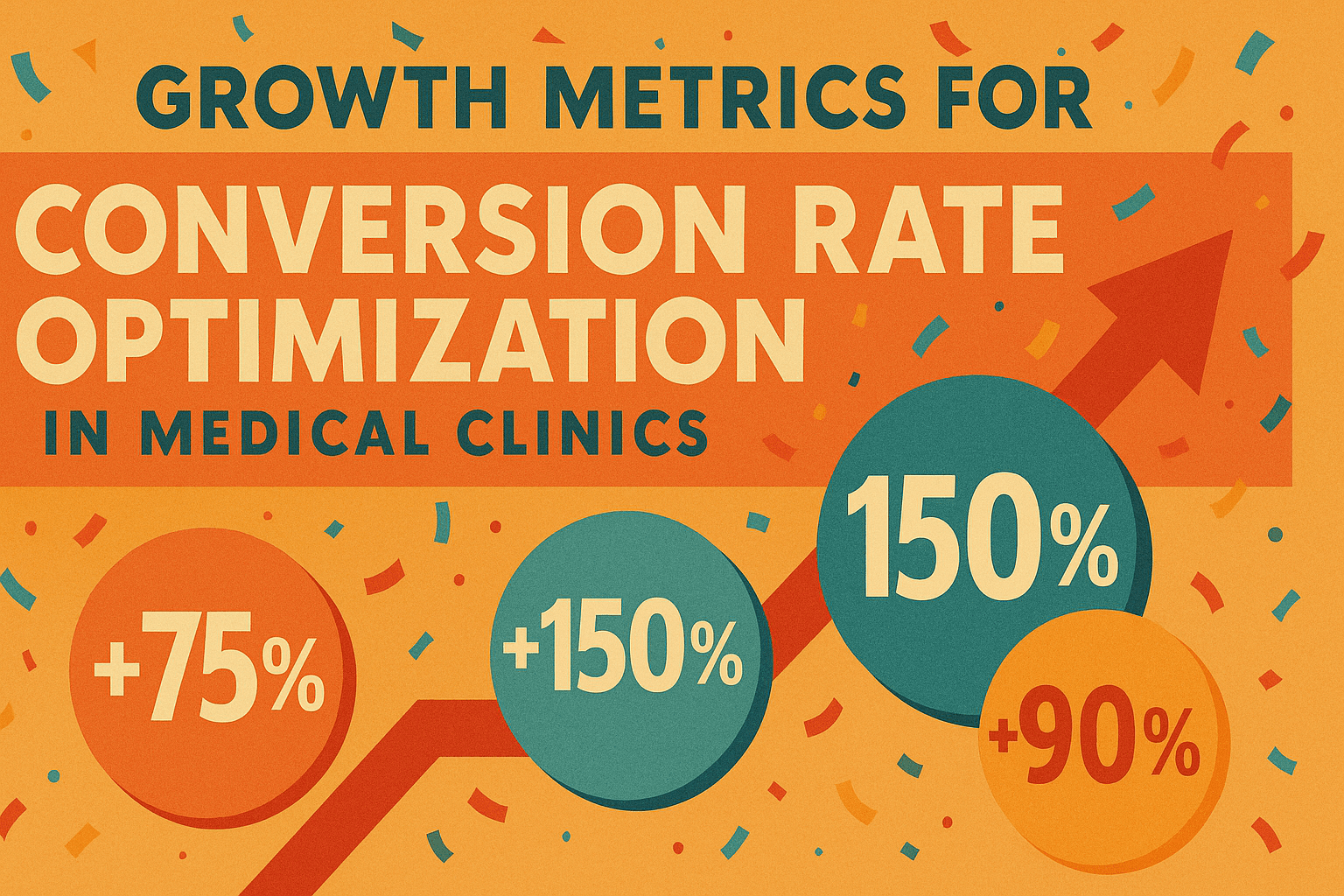
Measuring CRO Success: KPIs and Analytics
Effective measurement separates successful CRO programs from optimization theater. Medical clinics need metrics that directly connect website improvements to business outcomes—more booked appointments, increased patient volume, and improved marketing ROI.
Primary Conversion Metrics
Focus measurement on actions that directly generate revenue or patient growth. Secondary metrics provide context but shouldn't distract from outcomes that actually matter to your clinic's business objectives.
Essential KPIs to track:
- Appointment conversion rate: Percentage of website visitors who complete online booking or contact forms
- Phone call conversions: Number of calls generated from website click-to-call interactions
- Cost per acquisition: Total marketing spend divided by new patients acquired (tracking how CRO improves efficiency)
- Form completion rate: Percentage of users who start appointment forms and successfully submit them
- Landing page conversion rate: Performance of pages receiving paid or organic traffic in driving conversions
These metrics should be tracked in a unified dashboard that updates daily, providing real-time visibility into how optimization efforts impact patient acquisition. Many clinics make the mistake of tracking too many vanity metrics while losing sight of the numbers that actually drive growth.
Supporting Engagement Metrics
Secondary metrics help diagnose problems and identify optimization opportunities even when they don't directly represent conversions. These indicators reveal how patients interact with your website and where friction might be preventing conversions.
Diagnostic metrics include:
- Bounce rate: Percentage of single-page sessions, indicating relevance and engagement issues
- Time on page: How long patients spend reading content before taking action
- Pages per session: How many pages patients view before converting or leaving
- Exit rate: Which pages patients leave from most frequently, indicating potential friction points
- Mobile vs. desktop performance: Conversion rate differences across devices
Analyzing these metrics alongside primary conversions creates a complete picture of patient behavior. For example, high time on page combined with low conversion rates might indicate compelling content but unclear calls-to-action.
Attribution and Patient Journey Tracking
Most patients don't convert on their first website visit. They research, compare options, read reviews, and return multiple times before booking. Understanding this multi-touch journey is essential for accurate CRO measurement and attribution.
Advanced tracking considerations:
- Multi-touch attribution: Crediting conversions to all touchpoints in the patient journey, not just the last click
- Assisted conversions: Tracking how content and pages contribute to conversions even when patients don't convert immediately
- Return visitor behavior: Analyzing what brings patients back and what they view before converting
- Source-specific conversion rates: Measuring performance differences across organic search, paid ads, social media, and referrals
- Offline conversion tracking: Connecting phone calls and walk-ins back to website interactions when possible
Sophisticated tracking reveals that CRO improvements often have delayed impact. A better service page might not immediately increase conversions but could increase return visits and ultimate booking rates over time.
Common CRO Mistakes Medical Clinics Make
Understanding what doesn't work is as important as knowing best practices. Medical clinics frequently make predictable optimization mistakes that waste resources and sometimes harm conversions.
Testing Without Statistical Significance
Many clinics run A/B tests for a few days, see a winner, and immediately implement changes without reaching statistical confidence. This leads to false positives where random variation gets mistaken for meaningful improvements. Premature test conclusions often implement losing variations that actually decrease conversions over time.
Medical clinic websites typically need 2-4 weeks of testing to reach 95% statistical confidence, depending on traffic volume. Clinics with lower traffic might need multivariate testing approaches or sequential optimization rather than simultaneous A/B tests.
Copying Competitors Without Testing
Just because a competitor's website looks modern or uses specific design patterns doesn't mean those elements actually convert better. Every patient population, service offering mix, and competitive position is unique. What works for a high-volume urgent care chain might fail for a specialized boutique clinic.
The solution is testing everything rather than assuming best practices apply universally. Even widely accepted CRO principles should be validated against your specific patient behavior before full implementation.
Optimizing for the Wrong Metrics
Some clinics obsess over metrics like bounce rate or time on site without connecting these numbers to actual business outcomes. A page with a 70% bounce rate that generates 10 appointments per day is more valuable than a page with 30% bounce rate generating one appointment per day.
Always prioritize metrics that directly impact patient acquisition and revenue. Supporting metrics should inform optimization decisions but never replace outcome-focused measurement.
Ignoring Mobile Experience
Desktop-focused optimization while ignoring mobile creates a significant blind spot when mobile represents 60-70% of healthcare search traffic. Many clinics design beautiful desktop experiences that become frustrating on smartphones, losing conversions from their largest traffic segment.
Mobile-first design and testing ensures the majority of patients have an optimized experience. Desktop optimization remains important but shouldn't receive disproportionate attention relative to actual traffic distribution.
One-Time Optimization Instead of Continuous Improvement
CRO isn't a project with a fixed endpoint—it's an ongoing process of testing, learning, and improving. Clinics that optimize their website once and consider the work complete miss compound growth opportunities. The most successful programs treat optimization as a continuous discipline integrated into marketing operations.
Establish quarterly review cycles, maintain an active testing roadmap, and allocate ongoing resources to CRO rather than treating it as a one-time initiative.
Building a Sustainable CRO Program
Long-term CRO success requires more than just running tests—it demands organizational commitment, proper tooling, and embedded processes that make optimization part of your clinic's operational DNA.
Essential CRO Technology Stack
The right tools make optimization practical and scalable. Medical clinics need analytics platforms, testing tools, and research capabilities that work together to support data-driven decision-making.
Core technology requirements:
- Web analytics platform: Google Analytics 4 or similar for traffic analysis, funnel tracking, and conversion measurement
- A/B testing tool: Google Optimize, VWO, or Optimizely for running controlled experiments
- Heatmapping software: Hotjar, Crazy Egg, or Microsoft Clarity for user behavior visualization
- Session recording: Tools that capture actual user interactions for qualitative analysis
- Survey platform: On-site feedback collection to understand patient needs and objections
- Call tracking: Attribution for phone conversions back to specific marketing channels and pages
Many powerful tools offer free tiers adequate for small to medium-sized clinics. The key is implementing them correctly and actually using the data they provide rather than letting tools sit dormant.
Team Structure and Responsibilities
CRO requires cross-functional collaboration between marketing, operations, and technology teams. Successful programs clearly define who owns optimization strategy, test execution, design implementation, and results analysis.
Key roles in medical clinic CRO:
- CRO strategist: Owns testing roadmap, analyzes results, and drives optimization priorities
- Designer: Creates test variations, implements winning designs, and maintains visual consistency
- Developer: Implements technical changes, ensures proper tracking, and maintains website performance
- Content specialist: Writes conversion-focused copy, optimizes existing content, and creates supporting resources
- Analytics specialist: Configures tracking, produces reports, and identifies data-driven insights
Smaller clinics might consolidate roles or work with specialized agencies that provide complete CRO capabilities. The essential requirement is having someone accountable for driving continuous optimization rather than treating it as everyone's responsibility (which often means no one's priority).
Creating a Testing Culture
The most successful CRO programs foster experimentation mindsets where testing becomes standard practice rather than a special initiative. This requires leadership buy-in, reasonable timelines, and acceptance that many tests will produce neutral or negative results—and that's valuable learning.
Building testing momentum:
- Start with high-confidence wins: Begin with obvious friction points likely to show improvement, building credibility for the program
- Share results broadly: Communicate test outcomes, learnings, and impact to create organizational support
- Document everything: Maintain a test history showing what was tested, why, and what happened
- Celebrate learning: Frame negative test results as valuable insights rather than failures
- Maintain velocity: Keep multiple tests running continuously rather than sporadic bursts of activity
Over time, data-driven optimization becomes embedded in how your clinic approaches all digital marketing decisions. This cultural shift multiplies CRO impact far beyond individual test wins.
Getting Started: Your First 90 Days of CRO
Implementing conversion rate optimization can feel overwhelming, especially for medical clinics without dedicated digital marketing teams. A structured 90-day plan provides a practical roadmap for launching a CRO program that generates measurable results quickly.
Days 1-30: Foundation and Quick Wins
Week 1-2: Audit and Setup
- Verify analytics tracking is comprehensive and accurate
- Install heatmapping and session recording tools
- Document current conversion rates across all key actions
- Identify top 10 highest-traffic landing pages
- Review mobile experience on actual devices
Week 3-4: Quick Implementation Wins
- Fix obvious mobile usability issues (button sizes, form fields, load speed)
- Add click-to-call buttons prominently on mobile pages
- Simplify appointment booking forms by removing unnecessary fields
- Add trust elements (credentials, reviews) to service pages
- Implement clear, action-oriented CTAs throughout site
Days 31-60: Research and First Tests
Research Phase
- Analyze heatmaps and session recordings to identify friction points
- Survey recent patients about their website experience
- Review analytics to understand traffic sources and conversion paths
- Conduct competitor analysis of local clinics' websites
- Develop hypothesis backlog prioritized by expected impact
Testing Launch
- Start first A/B test on highest-traffic landing page
- Implement sequential testing on medium-traffic pages
- Begin tracking test results in centralized dashboard
- Document test setup, hypothesis, and expected outcomes
Days 61-90: Scale and Systematize
Scaling Wins
- Implement winning test variations across similar pages
- Update page templates with proven conversion elements
- Create documentation for conversion-focused content creation
- Launch second wave of tests based on initial learnings
Program Establishment
- Set up weekly reporting on conversion metrics and test results
- Create quarterly testing roadmap based on prioritized hypotheses
- Establish process for continuous optimization and iteration
- Calculate ROI from CRO program to justify continued investment
By day 90, you should have measurable conversion improvements, a validated testing process, and organizational momentum supporting ongoing optimization. Most clinics see 15-30% conversion increases within the first three months of structured CRO implementation.
Frequently Asked Questions
Let’s level up your Medical Clinics business
Need services that actually move the needle for Medical Clinics? See our approach, pricing, and timelines—then book a quick call.
Additional Resources
- Schedule a CRO Strategy Session
Book a complimentary 30-minute consultation to discuss your medical clinic's conversion challenges. We'll review your current website performance, identify immediate optimization opportunities, and outline a customized CRO roadmap aligned with your patient acquisition goals.
- View Our Medical Clinic CRO Portfolio
Explore real conversion optimization case studies and results from medical clinics we've helped transform. See before-and-after examples, testing methodologies, and measurable patient acquisition improvements across diverse healthcare specialties and practice sizes.
- Free CRO Tools & Resources
Access our collection of free conversion optimization tools built specifically for medical clinics. Calculate potential revenue impact from conversion improvements, audit your booking funnel, and download templates for running your first A/B tests.
Related Reading

Transform your construction contracting business with proven CRO strategies. Get more qualified leads, higher conversions, and measurable ROI. 🎯✨
Proven conversion rate optimization strategies for therapists & counselors. Increase appointment bookings, reduce cost per acquisition, and maximize practice growth with data-driven testing.
Discover 7 data-driven conversion rate optimization strategies specifically designed for dermatology practices. Increase patient bookings, reduce bounce rates, and maximize your marketing ROI with proven CRO tactics.