Personal Injury Law Automation: Complete ROI Guide & Implementation Strategy for 2025
by Eric Barker · November 11, 2025
Personal injury law firms handling hundreds of cases monthly are discovering that automation isn't just a productivity tool—it's a competitive advantage that directly impacts their bottom line. With the average personal injury case taking 14-18 months to resolve and requiring countless administrative touchpoints, the potential for efficiency gains through automation is substantial.
The financial impact is clear: firms implementing comprehensive automation strategies report 35-50% reductions in administrative costs while simultaneously improving client satisfaction scores and case outcome quality. This transformation isn't happening by accident—it's the result of strategic automation implementation that addresses the unique challenges personal injury practices face daily.
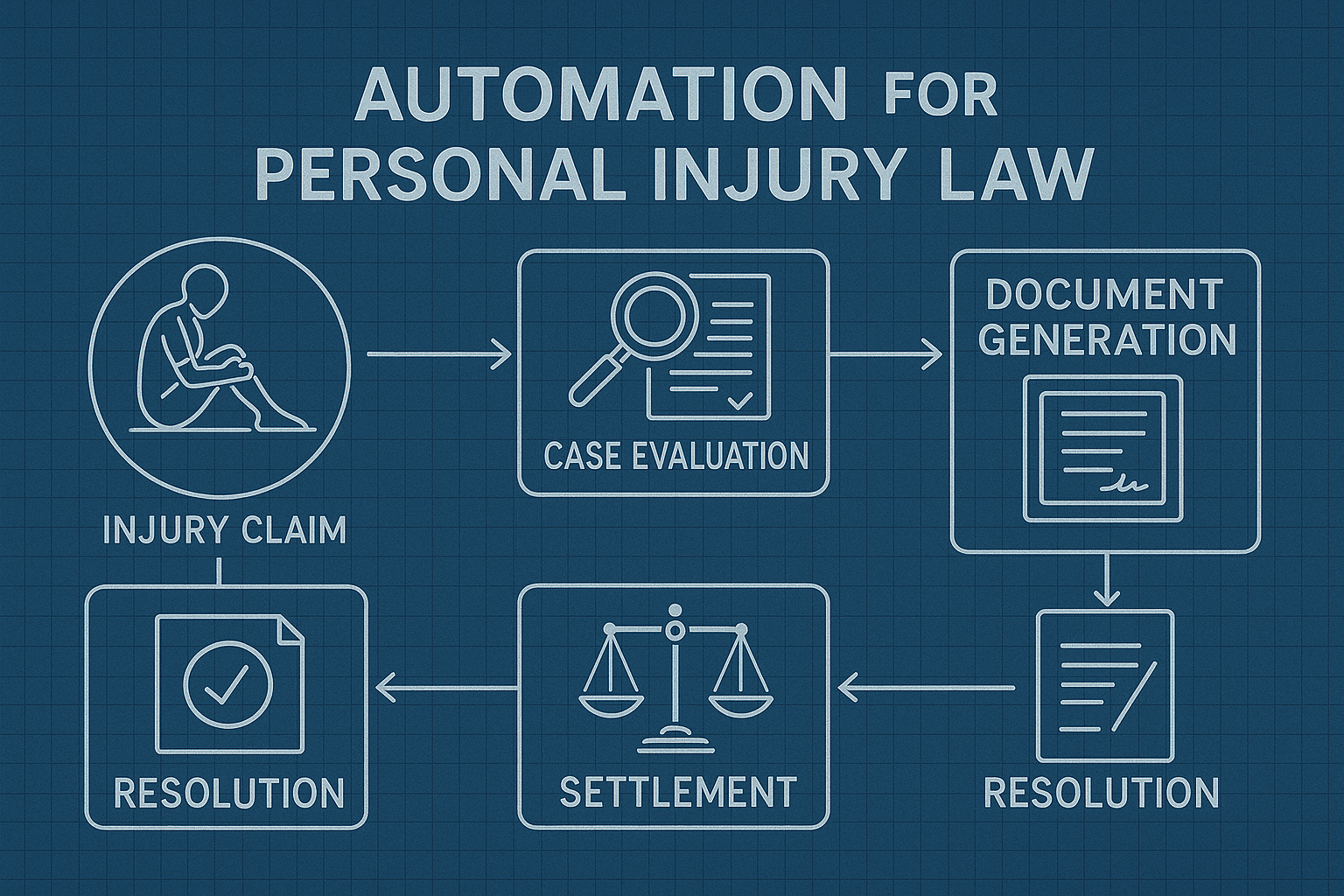
The Financial Case for Personal Injury Law Automation
Personal injury law firms operate in a unique environment where case volume, documentation requirements, and client communication demands create significant operational overhead. Understanding the specific ROI drivers for automation in this space requires examining both direct cost savings and revenue enhancement opportunities.
Direct Cost Reduction Areas
The most immediate financial benefits come from reducing administrative labor costs. Personal injury firms typically spend 40-60% of their operational budget on administrative tasks that don't directly generate revenue. Key areas where automation delivers measurable cost savings include:
- Document Processing: Medical record reviews, insurance correspondence, and legal document preparation can be automated to reduce processing time by 70-80%
- Client Communication: Automated status updates, appointment scheduling, and intake processes eliminate 15-20 hours of staff time per week in mid-sized firms
- Case Management: Automated deadline tracking, task assignment, and progress monitoring reduce case management overhead by 30-40%
- Billing and Collections: Automated invoice generation, payment processing, and follow-up sequences improve cash flow while reducing accounting costs
Revenue Enhancement Opportunities
Beyond cost savings, automation creates opportunities to increase revenue through improved case handling capacity and client acquisition efficiency. Firms implementing automation strategies report several key revenue drivers:
Increased Case Capacity: By automating routine tasks, attorneys and paralegals can handle 25-35% more cases without additional staff. This translates directly to revenue growth, as personal injury firms typically generate $150,000-$300,000 in revenue per attorney annually.
Faster Case Resolution: Automated case management and document processing can reduce average case resolution time by 2-3 months. Faster resolution means improved cash flow and the ability to take on new cases sooner.
Enhanced Client Acquisition: Automated lead nurturing and client onboarding systems improve conversion rates from initial consultation to retained client by 15-25%.
| Automation Area | Cost Reduction | Time Savings | Revenue Impact |
|---|---|---|---|
| Document Processing | 70-80% | 20-25 hours/week | $50,000-75,000 annually |
| Client Communication | 60-70% | 15-20 hours/week | $40,000-60,000 annually |
| Case Management | 30-40% | 10-15 hours/week | $30,000-45,000 annually |
| Lead Processing | 50-60% | 8-12 hours/week | $75,000-125,000 annually |
Core Automation Systems for Personal Injury Practices
Successful automation in personal injury law requires a strategic approach that addresses the most time-intensive and error-prone processes first. The following systems form the foundation of an effective automation strategy:
Client Intake and Lead Management Automation
The client acquisition process in personal injury law involves multiple touchpoints, from initial contact through case acceptance. Automation can streamline this entire process while improving conversion rates and client experience.
Automated Lead Scoring and Routing: Implement systems that automatically evaluate incoming leads based on case type, potential value, and firm capacity. This ensures high-value cases receive immediate attention while routine inquiries are handled efficiently.
Intelligent Intake Forms: Deploy dynamic intake forms that adapt based on case type and client responses. These forms can automatically trigger appropriate follow-up sequences and route cases to the most suitable attorney or paralegal.
Multi-Channel Communication Tracking: Integrate phone, email, web chat, and social media communications into a single automated system that tracks all client interactions and ensures no inquiry falls through the cracks.
Document Management and Processing Automation
Personal injury cases generate massive amounts of documentation, from medical records to insurance correspondence. Automation can significantly reduce the time and cost associated with document processing while improving accuracy and compliance.
Automated Document Classification: Use AI-powered systems to automatically categorize and file incoming documents based on content, source, and case relevance. This eliminates manual sorting and ensures important documents are immediately accessible.
Medical Record Analysis: Implement automated medical record review systems that can identify key information, flag inconsistencies, and generate summaries for attorney review. This can reduce medical record review time by 60-80% while improving accuracy.
Insurance Communication Automation: Automate routine insurance correspondence, including demand letters, status updates, and document requests. This ensures timely communication while freeing staff to focus on more complex negotiations.
Case Progress and Deadline Management
Personal injury cases involve complex timelines with critical deadlines that can make or break a case. Automated case management systems ensure nothing falls through the cracks while providing real-time visibility into case progress.
Intelligent Deadline Tracking: Implement systems that automatically calculate and track all relevant deadlines based on case type, jurisdiction, and specific circumstances. This includes statute of limitations, discovery deadlines, and court filing requirements.
Automated Task Assignment: Create workflows that automatically assign tasks to appropriate team members based on case stage, complexity, and staff availability. This ensures optimal resource allocation and prevents bottlenecks.
Progress Monitoring and Reporting: Deploy automated reporting systems that provide real-time visibility into case progress, potential issues, and performance metrics. This enables proactive case management and identifies opportunities for process improvement.
Client Communication and Relationship Management
Maintaining strong client relationships throughout long-duration personal injury cases requires consistent communication and proactive updates. Automation can enhance client satisfaction while reducing staff workload.
Automated Status Updates: Implement systems that automatically send case progress updates to clients based on predefined milestones and timelines. This keeps clients informed while reducing inbound inquiries about case status.
Appointment Scheduling and Management: Deploy automated scheduling systems that allow clients to book appointments online while ensuring optimal attorney availability and calendar management.
Emergency Communication Protocols: Create automated escalation systems that immediately notify appropriate team members when urgent client issues arise, ensuring rapid response to time-sensitive situations.
Implementation Strategy and Best Practices
Successfully implementing automation in a personal injury law practice requires careful planning, phased rollout, and ongoing optimization. The following approach has proven effective for firms of all sizes:
Phase 1: Assessment and Foundation Building
Begin by conducting a comprehensive audit of current processes to identify automation opportunities and establish baseline metrics. This phase typically takes 2-4 weeks and involves:
- Process Mapping: Document all current workflows, identifying pain points, bottlenecks, and opportunities for automation
- Data Analysis: Analyze historical case data to understand patterns, identify trends, and establish performance benchmarks
- Technology Assessment: Evaluate existing systems and identify integration requirements for new automation tools
- Team Readiness Evaluation: Assess staff technical skills and change management requirements
Phase 2: Core System Implementation
Focus on implementing the highest-impact automation systems first, typically client intake and document management. This phase usually takes 4-6 weeks and includes:
- Client Intake Automation: Deploy automated lead capture, scoring, and routing systems
- Document Processing: Implement automated document classification and filing systems
- Basic Case Management: Set up automated deadline tracking and task assignment workflows
- Staff Training: Provide comprehensive training on new systems and processes
Phase 3: Advanced Automation and Integration
Expand automation to more complex processes and integrate all systems for seamless operation. This phase typically takes 6-8 weeks and involves:
- Advanced Document Analysis: Implement AI-powered medical record review and analysis
- Comprehensive Case Management: Deploy full-featured case progress monitoring and reporting
- Client Communication Automation: Set up automated status updates and communication workflows
- Performance Analytics: Implement comprehensive reporting and analytics dashboards
Critical Success Factors
Several key factors determine the success of automation implementation in personal injury law practices:
Leadership Commitment: Successful automation requires strong leadership support and clear communication about the benefits and expected changes. Partners must be actively involved in the implementation process and champion the initiative.
Staff Engagement: Team members must understand how automation will benefit their daily work and career development. Involve key staff in system selection and implementation to ensure buy-in and adoption.
Gradual Implementation: Avoid trying to automate everything at once. Focus on high-impact areas first and gradually expand automation to additional processes as the team becomes comfortable with new systems.
Continuous Monitoring: Regularly review automation performance and adjust workflows based on real-world usage and feedback. What works in theory may need refinement in practice.
Measuring ROI and Performance Metrics
Tracking the return on investment for automation initiatives requires establishing clear metrics and monitoring systems. Personal injury law firms should focus on both financial and operational metrics to assess automation effectiveness.
Financial Metrics
The most important financial metrics for measuring automation ROI include:
Cost Reduction Measurements: Track reductions in administrative costs, overtime expenses, and temporary staffing needs. Calculate the dollar value of time savings by multiplying hours saved by average hourly costs for different staff levels.
Revenue Enhancement Tracking: Monitor increases in case capacity, improvements in case resolution times, and enhanced client conversion rates. These metrics directly correlate to revenue growth.
Cash Flow Improvements: Measure reductions in average collection times, improvements in billing accuracy, and increases in client payment compliance through automated billing and follow-up systems.
Operational Metrics
Key operational metrics provide insight into process improvements and efficiency gains:
- Case Processing Time: Track average time from case intake to resolution, identifying specific stages where automation has reduced processing time
- Error Rates: Monitor reductions in document processing errors, missed deadlines, and compliance issues
- Client Satisfaction: Measure improvements in client satisfaction scores, response times to client inquiries, and overall client experience ratings
- Staff Productivity: Track cases handled per attorney or paralegal, administrative time per case, and overall staff utilization rates
Benchmarking and Industry Comparisons
Understanding how automation performance compares to industry benchmarks helps identify areas for improvement and validate investment decisions. Key benchmarks for personal injury law automation include:
| Metric | Industry Average | Automated Firms | Improvement |
|---|---|---|---|
| Case Processing Time | 16-18 months | 13-15 months | 15-20% reduction |
| Administrative Cost Ratio | 45-55% | 25-35% | 35-45% reduction |
| Client Response Time | 24-48 hours | 2-4 hours | 85-90% improvement |
| Document Processing Accuracy | 85-90% | 95-98% | 10-15% improvement |
Technology Selection and Integration Considerations
Choosing the right automation technology requires careful evaluation of functionality, integration capabilities, and long-term scalability. Personal injury law firms have unique requirements that must be considered when selecting automation platforms.
Core Platform Requirements
Effective automation platforms for personal injury law must include several essential capabilities:
Legal Industry Specialization: Choose platforms designed specifically for legal practices, with built-in understanding of legal workflows, compliance requirements, and industry-specific features.
Integration Capabilities: Ensure new automation tools can integrate seamlessly with existing case management systems, accounting software, and communication platforms to avoid data silos.
Scalability and Flexibility: Select systems that can grow with the practice and adapt to changing requirements without requiring complete replacement.
Security and Compliance: Verify that all automation platforms meet legal industry security standards and compliance requirements, including attorney-client privilege protection and data encryption.
Implementation Timeline and Resource Requirements
Planning realistic implementation timelines and resource allocation is critical for successful automation deployment. Most personal injury law firms should expect the following timeline for comprehensive automation implementation:
- Planning and Preparation (4-6 weeks): Process assessment, technology selection, and team preparation
- Core System Deployment (6-8 weeks): Implementation of primary automation systems and basic training
- Advanced Feature Rollout (8-12 weeks): Deployment of sophisticated automation features and comprehensive integration
- Optimization and Refinement (Ongoing): Continuous improvement based on usage data and feedback
Change Management and Staff Adoption
Successfully implementing automation requires careful attention to change management and staff adoption strategies. Key considerations include:
Training and Support: Provide comprehensive training that goes beyond basic system operation to help staff understand how automation enhances their work and career development.
Gradual Transition: Implement automation gradually, allowing staff to become comfortable with new systems before introducing additional complexity.
Feedback and Iteration: Establish regular feedback sessions to identify issues, gather suggestions, and make necessary adjustments to automation workflows.
Common Pitfalls and How to Avoid Them
While automation offers significant benefits for personal injury law practices, several common pitfalls can undermine success if not properly addressed:
Over-Automation and Loss of Personal Touch
One of the biggest risks in implementing automation is removing too much human interaction from client relationships. Personal injury clients often require emotional support and personal attention that cannot be automated.
Solution: Focus automation on administrative and routine tasks while preserving human interaction for client consultations, case strategy discussions, and emotional support. Use automation to free up time for more meaningful client interactions rather than replacing them entirely.
Inadequate Data Quality and System Integration
Automation systems are only as effective as the data they process. Poor data quality or inadequate system integration can lead to errors, duplicated efforts, and frustrated staff.
Solution: Invest in data cleaning and standardization before implementing automation. Ensure all systems can communicate effectively and establish clear data governance policies to maintain quality over time.
Insufficient Training and Change Management
Many automation implementations fail due to poor staff adoption rather than technical issues. Without proper training and change management, even the best automation systems will not deliver expected benefits.
Solution: Develop comprehensive training programs that address both technical skills and workflow changes. Provide ongoing support and create incentives for staff to embrace new automated processes.
Unrealistic Expectations and Timeline Pressure
Expecting immediate dramatic improvements or rushing implementation can lead to disappointment and system failures. Automation benefits typically compound over time as systems are optimized and staff become proficient.
Solution: Set realistic expectations for automation benefits and timeline. Plan for a gradual improvement curve and focus on long-term ROI rather than immediate dramatic changes.
Future Trends and Emerging Technologies
The landscape of legal automation continues to evolve rapidly, with new technologies offering even greater opportunities for efficiency and effectiveness in personal injury law practice.
Artificial Intelligence and Machine Learning
AI and machine learning technologies are becoming increasingly sophisticated in their ability to analyze legal documents, predict case outcomes, and automate complex decision-making processes.
Predictive Case Analysis: Advanced AI systems can analyze case characteristics, historical outcomes, and current legal precedents to provide valuable insights into case value, likelihood of success, and optimal settlement strategies.
Automated Legal Research: AI-powered research tools can quickly identify relevant case law, statutes, and legal precedents, significantly reducing the time required for legal research and brief preparation.
Natural Language Processing: Advanced NLP systems can extract key information from medical records, police reports, and other case documents with increasing accuracy and speed.
Advanced Analytics and Business Intelligence
Sophisticated analytics platforms are enabling personal injury law firms to gain deeper insights into their operations, client needs, and market opportunities.
Performance Optimization: Advanced analytics can identify patterns in case outcomes, attorney performance, and operational efficiency to guide strategic decision-making and resource allocation.
Market Intelligence: Analytics platforms can provide insights into market trends, competitor activities, and emerging opportunities to help firms stay competitive and identify new revenue streams.
Client Behavior Analysis: Understanding client behavior patterns through data analysis can help firms improve client satisfaction, reduce churn, and optimize service delivery.
Integration with Emerging Legal Technologies
The legal technology ecosystem is becoming increasingly integrated, with automation platforms connecting to specialized tools for specific legal functions.
E-Discovery Integration: Automation platforms are integrating with advanced e-discovery tools to streamline document review and evidence analysis in complex cases.
Virtual Reality Case Reconstruction: Emerging VR technologies for accident reconstruction and case presentation are being integrated into case management workflows.
Blockchain for Evidence Management: Blockchain technology is being explored for secure evidence management and chain of custody tracking in personal injury cases.
Frequently Asked Questions
Let’s level up your Personal Injury Law business
Need services that actually move the needle for Personal Injury Law? See our approach, pricing, and timelines—then book a quick call.
Additional Resources
- Schedule Personal Injury Law Automation Strategy Consultation Call
Book a strategic consultation to discuss your firm's automation needs, implementation timeline, and expected ROI with our legal technology specialists.
- Personal Injury Law Automation Success Stories and Case Studies
Discover real results from personal injury firms using automation to increase efficiency, reduce costs, and improve client outcomes with detailed case studies.
- Free Personal Injury Law Automation Tools and Resources
Access free automation assessment tools, ROI calculators, process mapping templates, and implementation guides designed specifically for personal injury practices.
Related Reading

Discover how automation transforms physical therapy practices. Reduce admin time by 40%, improve patient engagement, and scale operations with proven automation playbooks.

Discover proven automation strategies for chiropractors. Streamline scheduling, patient communication, billing, and marketing to grow your practice efficiently.

Discover how automation for electricians streamlines scheduling, invoicing, lead tracking, and customer follow-ups to boost revenue and efficiency. Get started today.